Showing posts with label Birds of Prey Club. Show all posts

Tuesday, 11 March 2014

Club Day. The Birds of Prey version.

Yes, Birds of Prey Club is still happening, though my part in it is solely of the supervisor and snack provider nature.  Most meetings the boys conjure up fantasy roles and then spend most of their time talking about the role they've created for themselves, kind of like they're trying to one-up each other as to who has the most fantastical swords, grotesque bodies, or amazing superpowers.

Today, though, I was really hoping they would be up for some fort building.  You see, our neighbour shovelled the snow off her roof, and quite a bit of it landed between our houses...like four feet of it.


Having the sinking feeling that the folks the neighbour hired wouldn't be coming back to clean up the mess they'd left to seep into our basements, I took the kids outside, intending they would play happily and I would move snow.

But given that snow is everywhere around here, even though it is starting to melt, I quickly came to the realization that simply throwing the snow in the direction of the sidewalk would just be tiring.  And, as it happened that the top of the pile between the houses had a nice icy covering and the stuff below was being compressed by the stuff above, it was coming out in big chunks.  Perfect chunks for a snow fort to be built.  I called the kids over and suggested they start designing their fort.  And they did!


Here's what they built with about one third of the snow I hauled out.


Unfortunately, there was still quite a bit back there, and it needed somewhere to go.  But Birds of Prey Club was too lost in their imaginary world to be pulled out for a few blocks of snow.  Oh well.  They had fun.  They had a creative outlet.  And my kids have tomorrow to build another fort.

Tuesday, 29 October 2013

Club Day. The Birds of Prey Version.

Our meeting today was an experiment.  It was the "what will the Club do when I have prepared nothing for them to do?" meeting I thought we would try out a couple of meetings ago.  We came up with some interesting results.

Most of the boys decided they wanted to be silly.  Yes, that was an option that they wrote down on a list of things they could do.  And the one they chose.  So I politely asked them to get their shoes and coats on to take the silliness game outside.  I did follow them out too, at a distance, as sometimes this group doesn't quite see how fast they are approaching the line named "too far".  One clubber decided to build something while the others made up a hunting game.  I wasn't sure what to make of the division in the group, but let it happen and watched what would unfold.

Eventually, the Clubbers got cold and wanted to come inside.  This meant they all had to come inside.  And they all played together quite happily upstairs until the meeting was over.

And what do I make of our meeting today?  It's too early to tell.  It's too early to determine whether the odd man out thing will be consistent.  It's too early to tell how consistently the magic moments will appear, or if they even will happen consistently (magic has a funny way of appearing when you least expect it, I understand).  It's too early to tell how often the silly game will trump opportunities for creating either individually or together.  And I wonder if I will ever be able to figure out the triggers to the path they choose to take at our meetings, since I am not witness to how their day unfolds or to what extent they use the Club meetings as a time to decompress from the day.

So we'll take it meeting by meeting and see what we see. 

Tuesday, 15 October 2013

Club Day. The Birds of Prey Version.

We did it!  We finished the ornithopters today!  There was lots of slow, patient cutting of tissue paper and concentration as we connected all the pieces together.  There was a little of waiting for glue to dry.  There was some testing of the ornithopters, and fascination at watching the wings flap on their own (after the elastic that powers the whole thing was wound up, of course).  There was a bit of talk of pretending to be wizards, with the birds being a most wizardly accessory.  Then, I think, the clubbers decided that perhaps those birds should be handled quite carefully, and they were left to allow the glue to finish drying as the Clubbers burst outside to enjoy free time.


Wednesday, 2 October 2013

Club Day. The Birds of Prey Version.

Our meeting this week was a little like watching paint dry.  Except we were watching glue dry...really.  We continued on with building our ornithopters (more on that here).  At least along with watching all that glue dry, we have the body built and will be connecting the wings to the body next meeting.

The other wonderful thing that came out of sitting around watching glue dry was the space and time to scheme.  A door to ancient Egypt, with its folklore of Gods and heroes, was opened to one of our Clubbers, and he delightfully shared some of the allure of times long ago with the rest of the Club.  Which led to talk of Greek mythology.  Which then led to a drawing session where they created their own mythological Gods.  Which finally led to role-playing of their mythological world in our backyard.

I love watching how an idea grows organically into something tangible, with each child's own distinct fingerprint left clearly visible for all to see.  How they naturally gravitate to working out the details on paper, so they all can understand what one envisions their characters to embody...its essence and its physical being as well.  How they want to move beyond the two-dimensional form to fully living and breathing their character.  I'm feeling foolish for being in their way for so long.

Don't worry boys, I'll be out of your way soon.

Tuesday, 17 September 2013

Club Day. The Birds of Prey Version.

Ornithopter...I'd never heard of one of these until I started looking for plans for making our own flying machines, beyond the paper airplane variety.  As I searched, I stumbled across ornithopters... flying machines that are powered by rubber bands and designed so that the wings flap to keep them airborne.  I found kits for making them here. 

We worked together slowly, and got about half-way through their construction in thirty to forty minutes.  Then it was time to open the doors and let them get outside.  The boys' circumstances have changed since the spring...now, none of them attend the same school.  Two are at schools far enough away that they can't just walk over and meet us at the playground or on the way to our house.  They needed to have the space and time to be together and catch up.  This I was able to see with clarity.

So, once we're finished building our ornithopters, they will be on their own.  I won't be preparing any activities for them to do while they are here...they will have the freedom to create their own activities, role plays, skits, and whatever else.  There will be some limits...which materials can be used, the types and sizes of structures they create, as well as limits to ensure everyone's safety.  But for the most part, what they create and how will be theirs to own. 

Today felt like a self-imposed weight was removed.  I am thankful for seeing what was in front of me all along.

Tuesday, 20 August 2013

Club Day. The Birds of Prey version.

I was looking at the calendar last week, thinking that there wasn't too much time left before September, and that it had been awhile since our clubs had met.  My husband was going to be away this week, and I was looking at both the upside and the downside of having extra children running around the house. 

The upside? That the children would hang out with one another and enjoy one another's company.  That I would get a few more free moments to get Astrin fully moved into the room that she now shares with Jaelyn, sweep the mudroom floor and hang the laundry.  That I wouldn't stick the label of "bad mom" to my forehead as I worry about Nicholas' lack of desire to be with other children his age (as he tends to want to be alone or talk the ears off of the adults in the crowd).

The downside?  That the children would fight.  That someone would walk away angry or hurt or both.  That I would spend a lot of my energy smoothing over emotional crises. 

As you can see, the length of the reasons to have a meeting clearly outweighed the reasons to skip it for another week.  And so today there was a meeting.

We had a casual meeting - no agenda, no projects, no reviewing the Code of Conduct.  The "meeting" was just a guise to get everyone together.  And they boys did magnificent on their own.  They bantered about scorpions and insects, they compared ninjas and samauris, they did some drawing, and then did some informal drama out in the backyard.  I think they also played around with some Lego.

Which gets me to thinking about Birds of Prey Club in the fall.  The thing I loved about Birds of Prey Club last summer, and the thing I loved about it today, was that the boys had space and time to just be.  It brought out the best in them.  They imagined.  They shared factoids.  They disagreed about a lot of things, but they shared their opinions respectfully.  They followed their bodies own cues - they knew when they needed a bite to eat, when they needed to move, and when they needed to be quiet.  Could this crew of Clubbers be up for creating their own meetings, their own agendas, their own projects?  My fear is that in the dead of winter they will just want to blow off all the steam that has built up from being inside school for more than 6 hours straight.  That they will be a rowdy bunch of orangutans hanging from the light fixtures and chewing on the pillows (a bit of an exageration, perhaps).  But some ownership could bring about some pretty amazing stuff too.  Hmmm...something for my mind to work with over the next month or so. 

Tuesday, 25 June 2013

Club Day. The Birds of Prey version.

Today's post could have easily read something like "scavenger hunt gadgetry" or "jackpot denied".  We made the Birds of Prey Club navigation finale all about geocaching.  It seemed like an ideal way to cap off the work we had done on using compasses and understanding latitude and longitude.

Perhaps a definition is in order for those unfamiliar with geocaching.  In my own words, it is like a high-tech, world-wide scavenger hunt.  There are containers, "caches", hidden in various places in neighbourhoods, parks, urban, rural and wilderness locations around the world.  Inside the caches are a logbook and little trinkets - treasure!  Information about the caches, such as coordinates and clues, can be found via a web search.  The coordinates are plugged into a GPS unit, and you use the guidance of the GPS, plus your own smarts, to find the cache.  Once it is found, you sign the logbook and take a trinket, while being sure to leave a trinket for the next person to find the cache.  Oh, and you're supposed to do all this while not arousing the curiosity or suspicions of non-geocachers (known as "muggles" in the geocaching world).

The adventure started this morning, with Nicholas and I navigating our bus system (which currently has numerous detours due to summer construction) to our provincial Parks and Recreation Association to borrow GPS units.  They also provided some easy-to-follow instructions for how to enter coordinates, tips for finding caches, The Complete Idiot's Guide to Geocaching, and a tag we could place inside a cache once we found one.  All for free.  Sweet!

Nicholas and I discovered soon after that this whole geocaching thing sounded easier than it actually was.  In order to be inconspicuous, many caches are quite small and many are camouflaged and well hidden so they do not become accidentally discovered by "muggles".  The GPS is accurate enough to often get the searchers within 10 feet of the cache, but it can still feel like searching for a needle in a haystack, particularly since the GPS can't tell you whether the cache is hidden on the ground, dangling from a tree branch, or shoved into a tiny crevice somewhere in between (though the cache owner can provide hints or clues).  Many caches are also in quite public places (the ones we tried for a test drive were at a gas station and the library), so it felt impossible not to look a little strange while trying to track down these tiny caches.  Unfortunately, we struck out.

The two caches that were in the park by our house were labelled "micro" caches, which means they were similar in size to a roll of film.  Because we hadn't had any luck finding caches in the morning and I feared the same fate this afternoon, I pondered building a cache and hiding it in the park for the Birds of Prey Club to find.  Unfortunately, we ran out of time.  If I had the chance to do a do-over, I would have a contingency cache ready to go so it would be easier to set up a plan B.

At any rate, once the Clubbers were given a brief introduction to the GPS unit, we entered our coordinates and were off.  Of course, everything was easy until that last 10 feet - it appeared that our location was in between 4 trees.  We had a hint that the cache would be hidden about 3 feet high.  So we started our search by looking around each tree.  The Clubbers had interesting approaches to searching...some climbed trees to "get a better view", while others did a quick scan.  I tried to encourage them to think like the person who hid the cache - if it were them, where would they have hidden it?  We also tried to use other clues, such as areas where it looked like there was foot traffic where there shouldn't have been.  In the end, though, we had to wind up our search and we went home empty-handed.

The thrill of the hunt was definitely fun, though.  I think this thing could get addictive very quickly! 

Tuesday, 11 June 2013

Club Day. The Birds of Prey Version.

We're winding down the Birds of Prey navigation unit with a couple of hands-on, outdoor activities.  I'm so thankful the weather is cooperating today.  For today, we went straight to the park and sat under the shade of the trees for our snack, and then we went on a quest for treasure, using some real compasses.


I learned how to use a compass way back in grade 7.  Needless to say, I've forgotten most of what I learned, but it came back quite easily, thanks to Nicholas knowing how to use a compass (from Cubs) and the few instructions that came with the compass.  I also found help at this Learn Orienteering website.  And we got some extra practice as we went out to the park to set up the quest.

Our quest was pretty simple - follow the orienteering instructions to locate each of the 8 flags scattered throughout the park.  Each flag had a letter on it, and when all the letters were collected they could be unscrambled to make a word associated with our activity.  Participants would take a flag from the last location and return it to me for a prize, to celebrate them successfully completing their quest.

I chose to use flags stapled to the ground instead of pylons or flags attached to poles or sticks because I wanted the group to rely more on their compasses than on using the visual cues.  I also chose to set up two different routes so the groups wouldn't follow one another and not use the instructions.  Lastly, I set up the teams so that there was one person with more experience teamed with one with less experience.

Here are the materials we used, and more thorough instructions for setting it up:

Materials for setup:
 ~ compass
 ~ clipboard with paper and pencil
 ~ scrap fabric for flags (one for each location, plus one for each child at the last station)
 ~ garden staples for securing the flags to the ground
 ~ permanent marker (if doing a word scramble)
 ~ pylons

Setup instructions:
 1.  Use the permanent marker to write a letter on each flag that will be used in the word scramble.  We left the starting flag and the last flags blank.
 2.  Determine where your starting position will be and secure a flag to that spot using a garden staple.
 3.  Set pylons in the other locations.  We used pylons to lay out the course so they would be clearly visible when we went to write up the instructions, and so that we could make different routes using the same locations for each team.  My children set them randomly throughout the park.  Some were close together and some were far apart - this doesn't matter too much.
 4.  Stand at your starting position and select the next location you will orient to.  Using your compass, determine which direction you will need to face, in degrees.  Then walk towards that location, counting the number of steps.  Write down the degrees and the number of steps in your instructions.  Replace the pylon with a flag and secure it with a garden staple.  Note the letter on the flag so that you know the correct sequence for the word scramble.
 5.  From your current location, repeat step 4 until all locations have been included in the instructions.
 6.  If you want to write up several routes, simply put the pylons back over the flags, then repeat steps 4 and 5, using a different route.  We made sure the start and end positions were the same for each iteration of the course.

Materials for orienteering game:
 ~ compasses (one for each child)
 ~ clipboard with instruction sheet and pencil or pen
 ~ prizes (optional)

Game instructions:
 1.  Review with the group how to use the compasses.  Go through a couple of examples before they start their quest.
 2.  Divide the group into teams.  I tried to match those more experienced with using a compass with those who were using one for the first time.
 3.  Describe the activity to the teams.
 4. Give each team a clipboard with an instruction sheet and a pencil or pen.
 5.  Show each group where the start position is and let them begin! 

I preferred using map compasses that had a travelling arrow for this activity.  The travelling arrow (explained at the Learn Orienteering website) helped the children understand and see the direction they needed to move in better than other types of compasses without such a prominent feature.  I also found that I needed to remind them to hold their compasses level, move slowly, and to pick out some sort of landmark to walk towards (instead of looking at their compass and wandering off course).

I think we will definitely do this activity again!

Tuesday, 28 May 2013

Club Day. The Birds of Prey version.

Oh, I am so glad that we had an opportunity to test-drive today's Birds of Prey navigation-themed project before the Club actually showed up. 

I've been so excited and pleased with the projects in Tools of Navigation that I had great expectations for the homemade compass project described in the book.  It's a dry compass, which I had difficulty finding projects and instructions for making on the Internet.  The premise is that a milk carton bottom serves as the box that the compass resides in.  A heavy paperclip is magnetized, then sandwiched between two circular pieces of paper (one a cardboard and the other plain printer paper), which forms the compass rose.  Lastly, the rose balances on a nail or screw that comes up through the bottom of the milk carton.

Our problems began early during our experiments.  The book specified that the nail should be steel and not iron, presumably because the nail should not be attracted to the magnetized paperclip in the rose.  As I dug through the containers of nails and screws in our garage, I discovered that they were all attracted to magnets.  An internet search revealed that plain old steel will usually be attracted to magnets, but certain types of stainless steel will not.  My husband wound up finding five stainless steel screws in the basement, and my dad supplemented our collection.

Then we tried to build the contraption.  We found it extremely tricky to balance the rose on the screw, even before trying to sandwich the magnetized paperclip, and I expect that it wouldn't have stayed in place with the slightest movement or gentle breeze.  After three attempts, we decided to ditch the dry compass and went with a tried and true do-it-yourself water compass project.

The water compass project is quite easy, and there are may sources on the internet for finding instructions for how to do it.  The materials needed were simple - a circular piece of cork, a needle, a magnet, and something to hold water.  We cut up a few corks we happened to have handy to serve as our compass rose.  Then we magnetized a sewing needle by running a magnet over it for several minutes.  Lastly, we used the bottoms of the milk containers that we were planning to use for the dry compasses to hold the water.  The magnetized needle was then inserted through the side of the cork, and then the cork and needle was placed in the water.


I read a bit of the history and science of compasses to the Club as they magnetized their needles (from Tools of Navigation).  Did you know that while the Chinese invented the first compass (in 210 BCE), they didn't actually use it for navigation?  Instead, it was used in feng shui.  In fact, the first known recorded use of a compass for navigation in the western culture wasn't until the 1100's CE. 

We learn something new every day, don't we?

Tuesday, 14 May 2013

Club Day. The Birds of Prey Version.

I must say, I am loving the navigation and orienteering unit the Birds of Prey Club is working through this spring.  There have been so many neat, hands-on activities for us to do, in topic areas that are new to most of the kids.  Today the Club learned about topography and contour maps.

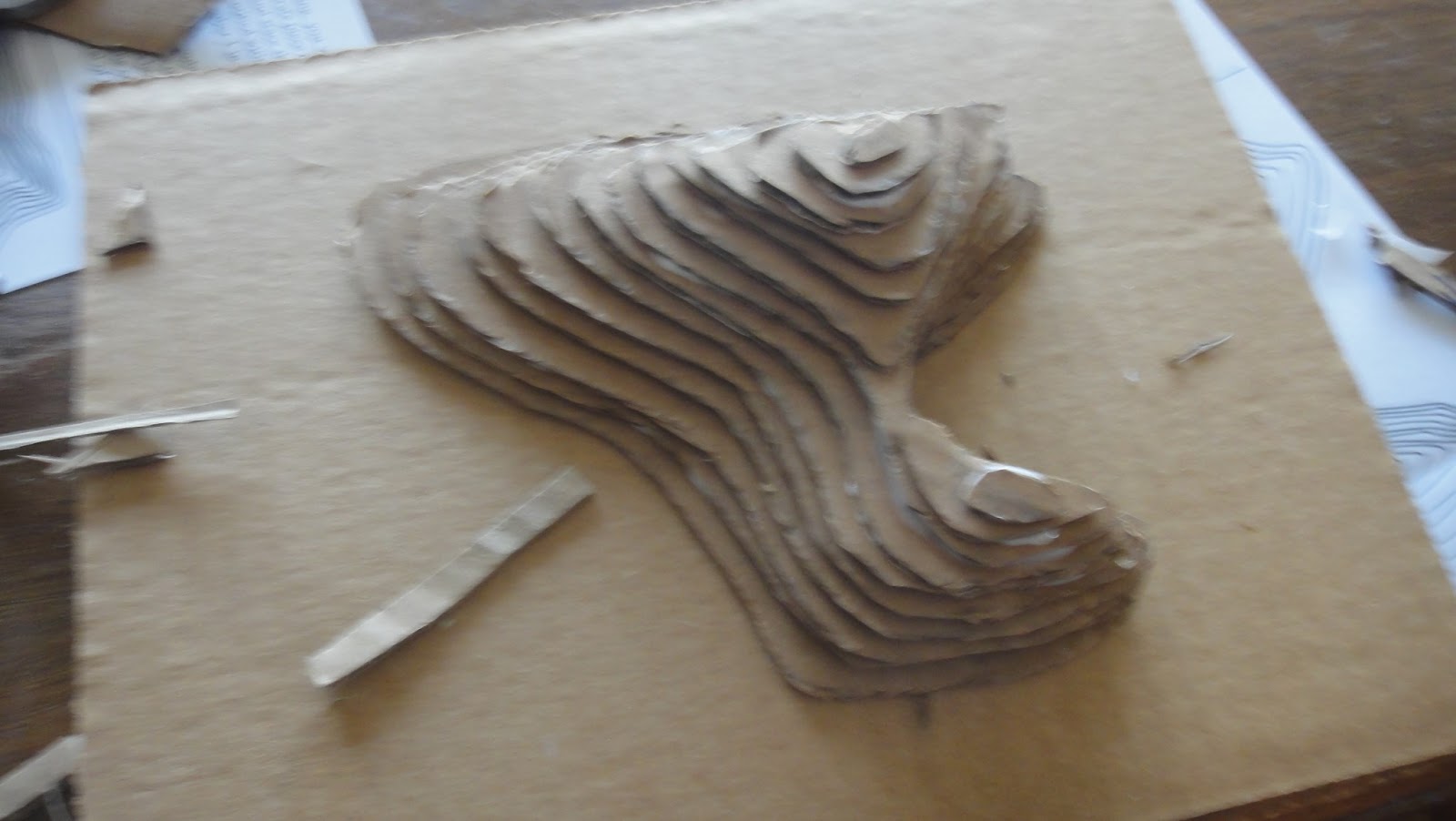
Our project was taken from The Sierra Club Wayfinding Book.  We looked at an example of a topographical map, taken from the book, and talked about the useful information this kind of map provides, particularly for those going on a hike that would prefer to avoid a steep cliff.  We talked about how the closer the contour lines are, the steeper the rise in elevation.  Then, we took an example contour map and made a 3D version to really drive the usefulness of the map home.

The simple map we used was provided in the book.  It consisted of 14 rises in elevation.  I traced each of the contours onto cardboard and numbered them to coincide with the numbers on the map.  The Club then had to cut them out and glue them in order, being sure to refer back to their map so that they could see where each contour needed to be placed in relation to the others.

This proved to be a challenging exercise for some of the Clubbers, as they had difficulty cutting the rigid cardboard.  I asked those Clubbers to do their best to cut around the outside of the shapes and then I trimmed the edges as necessary while they glued the layers of the map.  Others who were able to cut and paste on their own eventually made some modifications - a bridge here, a gondola there.  Some mentioned taking it home to paint or decorate with trees at a later date.


Now, to finish cleaning up the scraps of cardboard that surround my table!

Wednesday, 1 May 2013

Club Day. The Birds of Prey Version.

I'm so thankful for the navigation books I found at the library that are geared towards kids.  When we started this navigation unit, I only had three activity ideas:  learn how to use a compass, use a map, and geocaching.  Today though, thanks to these books, we took a brief foray into the navigational techniques of long ago and learned some basics about latitude and longitude.

At the last meeting, we talked about how virtually all birds use the sun to navigate, while fewer use the stars.  Today, we created a simple astrolabe, which was used by ancient seafarers to find their latitude with the help of the North Star (or Southern Cross for those exploring the Southern Hemisphere). 

The astrolabe project idea and instructions came from Tools of Navigation:  A Kid's Guide to the History & Science of Finding Your Way.  But before we dove into our project, we looked at a globe and talked about the lines of latitude and longitude.  We talked about how the equator is measured at 0 degrees and the poles are at 90 degrees, and that there are lines drawn on our globe that run horizontally that help us understand how far north or south we are.  Latitude was the focus of our discussion because the astrolabe can only be used to estimate latitude.  We did briefly talk about longitude, stating that they were the lines that ran perpendicular to the latitude lines, sharing that it took humans considerably more time to figure out how to measure longitude, and that location can be determined by knowing its latitude and longitude. 

The project itself was very easy to pull off - the only material we didn't have on hand were the protractors.  Asking the stars to come in the middle of the afternoon was trickier, so instead of using the actual North Star to determine our location, as the project directions instruct, we used other landmarks to get the hang of how to use the astrolabe and how to perform the calculations to estimate latitude.  I typed out instructions and sent these home with the Clubbers so that they could try to use them when they are out and about on evening excursions.

And we had fun going through the calculations as well!  The Clubbers pondered how their heads (and astrolabes) would be tilted if they were searching for the North Star while standing right on the North Pole, as well as at the equator.  At least one of the Clubbers wanted to continue experimenting with different landmarks.   

Tuesday, 16 April 2013

Club Day. The Birds of Prey Version.

Welcome, Birds of Prey Club, to our first meeting of this "spring" session.  This spring, we plan to learn about navigation and orientation, seeing as this is something that birds tend to be experts in.  I plan to gradually build up the sessions to be more complex or include more gadgets.  I'm also hoping the mountains of snow will disappear and that flooding won't be too extreme so we can do some geocaching without needing to dig through two feet of snow or wearing hip waders to find the treasure we're seeking.

Today, though, we're starting out with the most primitive of navigation techniques, as we'll do our best to replicate what our feathered friends do.  No tools.  Just nature.

To link this navigation unit with our beloved Birds of Prey, I did a bit of research to see what humans know about bird navigation.  It turns out that humans have not quite unravelled the mystery of how some birds can travel thousands of miles and arrive at their desired destination.  I shared the information from this website with the Club to give them an appreciation for how difficult it is to answer the simple question "how do birds navigate?"  Fortunately, part of the answer tied directly into our activity.

We moved our discussion outside and I provided each of them with a blank compass and a pencil.  I asked the children to tell me what they knew about how people would navigate before the days of compasses and GPS, and guided the conversation to talk of using the sun and the stars, as most birds do.  We observed where the sun was in the sky to determine which direction the club members were facing (which was a challenge given that the day was rather overcast).  We talked about which directions the sun rises and sets from, as well as where the sun is in the sky in relation to us in the northern hemisphere. 

Then we played a short little game where I gave them instructions to move in various directions and they were to complete the movements and determine what shape they had made as they moved from their starting to their finishing positions (the idea for this game came from here).  We started with a basic square (3 steps west, 3 steps north, 3 steps east and 3 steps south) and triangle (using the directions of west, northeast and southeast), then moved on to writing letters.  I mixed up the letters P-R-E-Y, then asked them to see if they could make up a word with the letters they walked out.

The children were able to cooperatively decide how to spend free time on their own, and the end of the session was very quiet as the clubbers went deep inside their imagination to draw dragons and birds. 

I'm looking forward to building a primitive navigation tool at the next meeting!

Tuesday, 26 March 2013

Club Day. The Birds of Prey version.

Before I get into the details of our adventures in soap carving with the Birds of Prey Club, I must share how interesting the walk to pick up the boys was. 

As usual, Nicholas and Jaelyn ran ahead while Astrin and I walked behind at Astrin speed.  And the things we noticed while we cruised along at Astrin speed.  She stopped to show me "dirty" that was left behind by a car.  She pointed out a piece of garbage that needed to be picked up.  We saw that snow was slowly beginning to melt, despite the temperatures staying substantially below zero for over a week now.  And it looked like the trees were preparing themselves to start budding (though that could have just been some eternal optimism on my part).

Yesterday, I described how we prepared for today's meeting.  There were some things that I wish I would have been more prepared for.  For example, I would have ordered the book, The Inuit:  Ivory Carvers of the Far North, from an out-of-town library branch.  This book was recommended here, and this blogger also provided a link for how to carve a polar bear.  This mama provided some wonderful tips, like using Ivory brand soap and making sure to have a tablecloth of some sort to catch all the shavings.

We got the idea for making our own tools from craft sticks here.  And because my children had so much fun making their own tools, I decided that the Club could make their own tools as well. 

Once the soap came out, I simply gave the Club a few tips, such as that scraping off little bits at a time to ensure the carving wouldn't break or crumble (which we learned the hard way yesterday).  I didn't provide them with any patterns, partly because I didn't think they would use them, and partly because I value providing children with opportunities to explore the given medium and create from their own imaginations.  I did, however, provide them with one resource that we could find at our local library on short notice:  Art of the Far North. 


Lastly, I wanted to get feedback from the Club on what activities they liked the most.  Here's what they shared:

  ~ Puppet making
  ~ Soap carving
  ~ Charades

Monday, 25 March 2013

Prepare and practice

Yesterday I was humming and hawing over what to do for the next Birds of Prey Club.  Nicholas had given me the awesome suggestion of navigation, and my mind was starting to wander with the possibilities...learning how birds navigate the world, particularly when most of them have such long distances to travel...learning how to use a compass and playing some compass games...doing some geocaching...perhaps getting into navigation of earlier times.

But something was holding me back, and I recognize now that it was my own need for order and flow.  My brain's desire for activities to tie to a central theme, and my gut churning because it felt that something in the winter session of the Birds of Prey Club just didn't get wrapped up.  This, of course, is okay.  There was plenty that we didn't get to, partly due to our brief need to bring some self-imposed order to our meetings, partly because of illness, and partly because I lacked energy to do the preparation needed to get to that end point I so desired.  Perhaps I was also reading that the group just wasn't into learning about the potential threats to the Arctic.

Somehow, inspiration came in the form of Inuit art, and opening the possibility of marrying an ancient craft with ancient navigation techniques.  We would briefly explore Inuit culture (including the role of Inuksuks and carvings) and finish with carving soap in whatever form the children chose.

I have never carved soap before, so I headed straight to the internet to learn more.  My first couple of finds made me reconsider the wisdom of this project.  For I saw a gentleman sawing away pieces of soap, and another using what looked like a very large carving knife.  This was not what I had in mind, and panic briefly struck me. 

Fortunately, narrowing down my search to "soap carving with children" provided some much more kid-friendly results, which I'll share tomorrow. 

For today, though, we prepared and practiced.  We brought out some craft sticks and some sandpaper to make some rudimentary carving tools.  We cracked open a couple of bars of soap to see if our tools would work, and to learn some of the hands-on "do's" and "don'ts".

Here's looking forward to tomorrow, knowing that at least the craft part of our afternoon is ready to go.


Tuesday, 12 March 2013

Club Day. The Birds of Prey Version.

Ah, welcome back, Birds of Prey Clubbers!  And a most gracious thank you to my husband, who rescued me from the depths of a killer headache, chills, and nausea to take over the club this afternoon.  While I was out of bed for the club, I wasn't up for the short hike to the school and some of the negotiations that come along with a pack of boys all wanting to do different things.

We welcomed a new Clubber and welcomed back a veteran Clubber today, so we reviewed the Code of Conduct we created at the last meeting. With no adjustments needed, we were good to go with the main part of our meeting.

I've struggled to keep activities fresh for this group of older boys.  While most seem to like crafts in spurts, I don't sense it would be something they would like to do at every meeting.  And I've been wanting to find activities where they can use their bodies and get some of that energy out that I assume must be pent-up from a day sitting in a desk.  At any rate, today we played Birds of Prey charades.  I was hoping the game would get their bodies moving, allow for some free-flow creative thinking, and just be fun.

I think they did have fun, and we all had a few laughs.  Who knew that acting out a vole could be interpreted as a "constipated dog"!  There was lots of wing flapping and collapsing on the floor, as different species and their body parts all seemed to be acted out the same.  We did try to teach them some "shortcuts" to their charades - like showing how to communicate how many words would be acted out and using "sounds like" to give more clues. 

And I'm happy to report that the code was followed to the letter...except when all were shouting out their guesses during our game.  That was a welcome exceptions, however.

Tuesday, 26 February 2013

Club Day. The Birds of Prey Version.

After the last Birds of Prey Club meeting, I posted that the boys seemed at odds with each other more often and I put together a few thoughts for how I would try to get things back on track.

And today was the day to put it into action.  I didn't do all the things I first mulled over, simply because time wouldn't allow it.  What we did do, though, seemed effective, so I'm happy.

First, I read the Club the story Look to the North:  A Wolf Pup Diary.  It talks about the first 10 months of a wolf cub's life, including how it learns it's place in the pack, how they learn to hunt, and how wolves communicate with one another.  Along the way, I asked questions to teach about some of the facts in the book.  What is the longest day of the year?  When are day and night of equal length?  What is nursing?

Then, we talked about the similarities and differences between wolf behaviour and human behaviour.  I learned that many scientists believe that no other animal family acts more like humans than a wolf pack (from Scruffy:  A Wolf Finds His Place in the Pack).  So these books seemed like a perfect fit for our discussion on how we treat one another in our Birds of Prey Club family.

Next, the Club put together a short "Code of Conduct" and also came up with consequences for not sticking to the Code.  This is what they came up with:

"The Code"

1.  No swears
2.  Hands, bodies, and other objects stay off others
3.  One person speaks at a time
4.  Respect other people's things
5.  No talk of alcohol
6.  Try not to be hyper - consider the volume of your voice and being in control of your body. 

The Consequences - "4 strikes"

1.  Warning
2.  5 minute time-out
3.  7 minute time-out
4.  Call parents to take you home.

I'll be sending this out to parents and we'll also have a quick talk about it at the last meeting.  This will simply remind the Club of the "Code" they created and will allow one of our Club members who could not join us today an opportunity to ask questions and add any information that he feels would be relevant.

All in all, a successful meeting

Tuesday, 12 February 2013

Club Day. The Birds of Prey version.

The weather cooperated this week, so we did the activities that I had planned for the last Birds of Prey Club meeting.  As we ate our snack, we talked about some of the adaptations of animals of the Arctic.  The club came up with several answers, like the colour of their camouflage, their fur, increased fat stores, and the size of some animals' paws.  Then, we strapped on snowshoes and took a short hike through the deep deep snow in the park by our house. 

We found a little area of the park edged with bushes and gathered to play our first version of Predator and Prey.  I asked the Club to name an Arctic prey and an Arctic predator, then they were off to play our birds of prey version of tag with snowshoes.  Next, we talked about camouflage and we played a few short games of hide and seek, using two canvas sheets I had brought along as camouflage.  I didn't have enough for everyone, but those who didn't have camouflage made for the bushes to try and blend in there.  Lastly, we took off the snowshoes so we could play one last game of Predator and Prey - our animals this time were a moose and a wolf (who do not live in the Arctic, but do live quite far north and use different adaptations to survive harsh winters).  If only these little ones had legs that were as long as a moose's - it was hard enough to move around in the deep snow with snowshoes, let along without them!

We did have a few rough patches during this meeting - whether it was hurt feelings or a hurt body - and everyone suffered.  To get this group all on the same page of how we will treat one another, I will be dedicating the next meeting to behaviour, and yet I know that a lecture on how to treat one another won't be effective.  I do know that the room is quiet when I read a book, so I will be researching animal social structure and behaviour to introduce these ideas.  Even better, perhaps I'll see if Nicholas has any recollection of reading about these topics in the myriad of owl books he's flipped through.  Maybe Nicholas and I can even write up our own stories if we can't find one that suits our needs. 

Hmmm....now I'm starting to get excited about preparing for this next meeting!

Tuesday, 29 January 2013

Club Day. The Birds of Prey Version.

Today the Birds of Prey Club is starting a new theme.  I really have come to the end of pure birds of prey themes, so we are starting a unit on Arctic animals and peoples, inspired by one of Nicholas' much loved owls, the Snowy Owl. 

I stumbled upon this theme quite by accident.  I received an email from Greenpeace in December, advertising a new website they'd set up, Arctic Rising.  It's a toolkit that young and old can use to raise awareness about threats to the Arctic. 

I thought it would be too big of a leap to simply start exploring the issues facing the Arctic environment and Arctic peoples.  So, we're starting off slow by exploring some of the Arctic animals, including the adaptations they've made to survive in such a unique environment.  Our plan today was to identify some animals and then head to the park to see how some of the adaptations they've inherited help them to thrive.  We were going to explore camouflage, inspired by the colour changes of the Arctic Fox and Arctic Hare, by playing hide and seek with winter camouflage and without.  Then, we were going to explore a simple physical adaptation of paw size for walking in snow.  We were going to play predator and prey with and without snowshoes. 

But it was not to be today.  The weather turned bitterly cold, and not all the Clubbers were dressed for the outdoors.  So, we'll save those ideas for another day.

Today, we read the book Ookpik:  The Travels of a Snowy Owl.  It tells the tale of survival of a young Snowy Owl from its birth through its return to the Arctic after migrating for its first winter.  It has fabulous illustrations, and there was just enough factual material woven into the story that we could have a couple of discussions about adaptations of the Snowy Owl.  It was amazing how quiet this group of rowdy boys were for the entire story.  Then, we broke out the art materials and the boys had an opportunity to draw or paint something that touched them from the story.  This was a very open-ended activity, where they could draw a landscape, an animal, or what they thought it might feel like to be one of the animals from the story.


As I was scouring the internet for other ideas, I came across a website that shows promise for inspiring future meetings.  I think this little club will be the neighbourhood's foremost experts on the Arctic by the time we're done this theme!

Wednesday, 16 January 2013

Dem bones. And a recap on Birds of Prey.

Yesterday, my husband took the reins for the day's homeschooling adventures, while I was on a training course.  When I asked him how the day went, his only word was "fast".  Coincidentally, the first Birds of Prey Club meeting of 2013 was yesterday.  So, he was responsible for coming up with an activity, sharing it with the club members' parents, and then following through on those plans.  I did ask him if he wanted to do a guest post, and while he didn't say no, he didn't say yes either.  So here's a little recap of their afternoon.

Chris wanted to introduce the Club to bird calls.  First though, he wanted to give them a sense as to what it would be like to track an animal in the wild.  Being in an urban area, there isn't reams of wildlife - squirrels, small birds, cats and dogs rule the day here - so they played Let's Go Hiking (see here for more on our other experiences with the game).  I understand the room quieted down quite a bit once they got into the thick of it, and they had to negotiate with one another a few times.

Chris found some bird calls here.  He gave the club hints, like what the bird looked like, where it lived, what it preferred to eat, then he played the call.  As I understand it, the boys were begging to try just one more call as the end of club time was drawing near.

Today, I led our homeschool co-op through some learning about bones.  The co-op moms decided we would focus on all things science during the winter.  With limited planning time (if a week and a half is limited), I was a little mystified with what I could do, and what I would feel comfortable teaching.  After all, the last time I did anything related to "science", beyond gardening and cooking, was...hmmm....when I tried to take a university physics course by correspondence, and stumbled all over Newton's laws.  But before that, I had a love affair with anatomy and physiology.  This too I hummed and hawed over, because I didn't know if the kids would be interested.  Then I thought about some of my awesome teachers, and how the subject came alive simply because they were so passionate about it.  And I remember how I became more amazed and in awe of the human body just by better understanding how it worked.  So surely, if I showed up with the same amount of enthusiasm, it would rub off on someone.

The next trick was finding a suitable level of challenge for all in our group.  It was possible I would be working with children whose ages ranged from 4 to 10.  I decided to have some very basic things (singing "Head, Shoulders, Knees, and Toes" and "Dem Bones") while also providing challenge by introducing the words in a different language (French), and the scientific names.  We talked about how the scientific names helped scientists speak in the same language and communicate about the body very precisely.  Then we talked about how many of the bony structures in a human body are named the same as those in another animal's body. 

While I was planning, I found I was struggling with how to give the children something to explore with their hands.  I wondered if I could borrow a human skeleton from somewhere.  I wondered if using anatomy colouring pages would really give the children the depth I wanted to provide them with.  With my brow furrowed, deep in though as to how to make bones tangible, I stumbled across the last of our stash of owl pellets.  Yes - I had that hands-on experience I wanted to provide, just in the form of a rodent instead of the human form I was more familiar and comfortable with.  

There was some apprehension from some of the children because of the tactile sensation of touching wet fur (we soaked the pellets before dissecting them).  It seemed, though, that once they saw a peak of their first bone, the apprehension fizzled away.  And I had a great time sharing some of my knowledge with these little ones.  We had a few exciting moments - one was when we found a vole skull fully intact - we could see the opening where the brain stem would leave the skull, which was a first for all the pellets we've been through.  I heard one child shout out "I found a humerus!" (upper arm bone), and was delighted that the songs we sung may have helped her remember the scientific names. 

Here are some websites I found that may help you and yours dive into the world of bones:

  ~ Build a skeleton on-line
  ~ Spongelab Build-a-body
  ~ Student activity page for dissecting an owl pellet, with links to the human skeletal system

Oh, what a fun afternoon!

Tuesday, 20 November 2012

Club Day. The Birds of Prey Version.

Today was the last session for the fall for the Birds of Prey.  Nicholas has been begging to dissect owl pellets, and today his wish came true.

What is an owl pellet you ask?  Here's the non-scientific definition:  it is a combination of owl puke and owl poo.  Any part of an owl's meal that can't be digested (fur, bones, teeth) is regurgitated in the form of a hard pellet. 

I found my owl pellets locally through one of our used websites - it turns out there was a former science teacher getting rid of his stash of science goodies.  He also provided me with a layout of a vole skeleton and some general instructions for what to do.

We decided to do a trial run last night.  We soaked the pellets for about 20 minutes so that we wouldn't break the delicate bones inside while opening the pellet.  Then we gathered our equipment - tweezers and toothpicks, plus somewhere to put the bones - then drained the water.

We measured our pellet (scientifically yesterday with a tape measure, while today we eyeballed it).  Then we gently broke them open and started sifting the bones and teeth from the fur.  For the boys, it seemed that they had hit treasure when they found the skull or the larger bones of the hips, femurs or humerus's.  We talked a bit about how the skeleton of an animal, such as a vole, is remarkably similar to that of a human (so similar that the bones often have the same names), and how the highest concentration of bones for both mammals are in the hands, feet and torso.  We also talked about how the vertebrae with the larger holes are closer to the head, as the brain stem and spinal cord near the head are larger and therefore need a wider opening to go through.

After a while, they did find it tedious to fish out all the metacarpals, metatarsals (paw bones), ribs and vertebrae.  One Clubber did make an attempt to put together the larger bones of the skeleton.  I was happy, though, to hear their shrieks as they found another bone. 


Treasure, I tell you!