We're taking our exploration of the human body system by system and up next was the circulatory system. We were fortunate to take our learning outdoors and do a couple really wonderful activities to get the children engaged and interested to learn more.
In researching activities for us to do, I read a comment about science being an incredibly difficult subject for children to learn traditionally because it requires learning both a new vocabulary as well as the actual scientific concepts being introduced. I even watched a Ted Talk about this very same thing a few months ago. Sadly, I also witnessed it first-hand when we went through some of the finer details of the digestive system. I'm finding many library books too detailed for my little ones to discern the main points. I was thankful to find Hear Your Heart, as it introduces the main points in simple terms and straightforward language. We kicked off our circulatory system adventure with this book.
We went on to do several experiments and activities, these coming from How the Body Works. We felt around for our pulses and learned that the feeling is the blood being pushed through our arteries. We made a stethoscope out of plastic tubing and a funnel so that we could hear our heart sounds. Then we discovered that our heart beats faster after exercise...and the more intense the exercise, the harder and faster it beats. We learned this by comparing our resting heart rates to our heart rates after one minute of exercise (jumping jacks) and two minutes of exercise (running around the block). We also learned a bit about blood, including some of the substances in our blood, how a scab is formed, and foods that can help our blood stay healthy.
There are several pretty neat concoctions in Hands-on Grossology - one for fake wounds and the other for making fake blood. I'm reluctant because of the mess they will make, but I know the kids would get a kick out of it and would likely make them again as they continue their battle scenes. We'll see if my reluctance lifts as the week progresses.
Showing posts with label head. Show all posts
Monday, 16 September 2013
Wednesday, 4 September 2013
Aliens...but not what you think!
We kicked off the formal part of our homeschooling journey last year with a unit study on the solar system. It seemed to work for us to do a deep dive into a topic, with lots of hands-on activities and links to language arts and math. I loved reading the poetry we found, the paintings we created, and the Greek and Roman mythology we followed up every planet with. And the factoids and science behind the planets and the solar system as well, of course.
This year we're starting off the year with a deep dive into the human body, with any and all links to others in the animal world happily accepted. After chatting about all the different body parts - bones, muscles, organs, skin... - we took some time to trace each other. These life-size representations of the children are now hanging on our walls, and greet any and all visitors who make their way through our front door. As I was snapping pictures of my new paper greeters, I stood back and realized that they each, in their own unique way, look a bit like aliens. So alien greeters they are.
In all seriousness though, our intent is to learn about a new body system each week, culminating at the end of the week with drawing, cutting and pasting the system onto the tracings now gracing our walls. Our first look is into the digestive system. We've taken a first look at the organs within that system and read a really accessible book - What Happens to a Hamburger? - describing what happens during the digestive process. We found a length of rope and measured off the length of the digestive system if it was laid out flat on the ground as opposed to twisted and bunched together in the abdominal cavity of a person. We talked about how long food hangs out in each part of the digestive system. Fun, quick, hands-on, and great for all ages! And plenty of factoids too!
Tuesday, 11 June 2013
Club Day. The Birds of Prey Version.
We're winding down the Birds of Prey navigation unit with a couple of hands-on, outdoor activities. I'm so thankful the weather is cooperating today. For today, we went straight to the park and sat under the shade of the trees for our snack, and then we went on a quest for treasure, using some real compasses.
I learned how to use a compass way back in grade 7. Needless to say, I've forgotten most of what I learned, but it came back quite easily, thanks to Nicholas knowing how to use a compass (from Cubs) and the few instructions that came with the compass. I also found help at this Learn Orienteering website. And we got some extra practice as we went out to the park to set up the quest.
Our quest was pretty simple - follow the orienteering instructions to locate each of the 8 flags scattered throughout the park. Each flag had a letter on it, and when all the letters were collected they could be unscrambled to make a word associated with our activity. Participants would take a flag from the last location and return it to me for a prize, to celebrate them successfully completing their quest.
I chose to use flags stapled to the ground instead of pylons or flags attached to poles or sticks because I wanted the group to rely more on their compasses than on using the visual cues. I also chose to set up two different routes so the groups wouldn't follow one another and not use the instructions. Lastly, I set up the teams so that there was one person with more experience teamed with one with less experience.
Here are the materials we used, and more thorough instructions for setting it up:
Materials for setup:
~ compass
~ clipboard with paper and pencil
~ scrap fabric for flags (one for each location, plus one for each child at the last station)
~ garden staples for securing the flags to the ground
~ permanent marker (if doing a word scramble)
~ pylons
Setup instructions:
1. Use the permanent marker to write a letter on each flag that will be used in the word scramble. We left the starting flag and the last flags blank.
2. Determine where your starting position will be and secure a flag to that spot using a garden staple.
3. Set pylons in the other locations. We used pylons to lay out the course so they would be clearly visible when we went to write up the instructions, and so that we could make different routes using the same locations for each team. My children set them randomly throughout the park. Some were close together and some were far apart - this doesn't matter too much.
4. Stand at your starting position and select the next location you will orient to. Using your compass, determine which direction you will need to face, in degrees. Then walk towards that location, counting the number of steps. Write down the degrees and the number of steps in your instructions. Replace the pylon with a flag and secure it with a garden staple. Note the letter on the flag so that you know the correct sequence for the word scramble.
5. From your current location, repeat step 4 until all locations have been included in the instructions.
6. If you want to write up several routes, simply put the pylons back over the flags, then repeat steps 4 and 5, using a different route. We made sure the start and end positions were the same for each iteration of the course.
Materials for orienteering game:
~ compasses (one for each child)
~ clipboard with instruction sheet and pencil or pen
~ prizes (optional)
Game instructions:
1. Review with the group how to use the compasses. Go through a couple of examples before they start their quest.
2. Divide the group into teams. I tried to match those more experienced with using a compass with those who were using one for the first time.
3. Describe the activity to the teams.
4. Give each team a clipboard with an instruction sheet and a pencil or pen.
5. Show each group where the start position is and let them begin!
I preferred using map compasses that had a travelling arrow for this activity. The travelling arrow (explained at the Learn Orienteering website) helped the children understand and see the direction they needed to move in better than other types of compasses without such a prominent feature. I also found that I needed to remind them to hold their compasses level, move slowly, and to pick out some sort of landmark to walk towards (instead of looking at their compass and wandering off course).
I think we will definitely do this activity again!
Thursday, 18 April 2013
Polar bears
As the sun rose today, I awoke to the realization that this was the first night in over a week that I hadn't tossed and turned for the better part of the night. Then, as I took my first tentative bites of breakfast, I found that my stomach wasn't twisting and turning. I didn't feel winded walking up the stairs. Could it be that I've finally kicked this bug that has been plaguing me for the last week? I hope so!
And the things we could do today now that I have the energy to send my attention out to others! It turned out that Jaelyn had most of her formal lesson work done before the school bus had even driven past our house this morning, so we proceeded to do some more research on polar bears for next week's science fair. We found several websites that had pretty incredible video footage, facts from the mouths of scientists who actually study the bears, and easy-to-understand write-ups about the bears. The sites we were most impressed with were Polar Bears International and National Geographic for Kids.
Now that we've done a deep dive, Jaelyn and I will be talking about what information she would like to share at the science fair and how she would like to share it. I've been brainstorming a bit myself, in case we need some inspiration. Life-size drawings, paw casts made out of clay or modelling clay, and acting out the bear's gait as it crosses ice are all ideas that have crossed my mind so far. I do intend for Jaelyn to come up with her own ideas and that she will lead carrying them out. My act of brainstorming is simply to open my own mind to the possibilities that are out there, beyond the pen-and-paper medium that I'm most comfortable with and accustomed to.
I'm looking forward to seeing how this will play out over the days ahead!
Tuesday, 12 February 2013
Club Day. The Birds of Prey version.
The weather cooperated this week, so we did the activities that I had planned for the last Birds of Prey Club meeting. As we ate our snack, we talked about some of the adaptations of animals of the Arctic. The club came up with several answers, like the colour of their camouflage, their fur, increased fat stores, and the size of some animals' paws. Then, we strapped on snowshoes and took a short hike through the deep deep snow in the park by our house.
We found a little area of the park edged with bushes and gathered to play our first version of Predator and Prey. I asked the Club to name an Arctic prey and an Arctic predator, then they were off to play our birds of prey version of tag with snowshoes. Next, we talked about camouflage and we played a few short games of hide and seek, using two canvas sheets I had brought along as camouflage. I didn't have enough for everyone, but those who didn't have camouflage made for the bushes to try and blend in there. Lastly, we took off the snowshoes so we could play one last game of Predator and Prey - our animals this time were a moose and a wolf (who do not live in the Arctic, but do live quite far north and use different adaptations to survive harsh winters). If only these little ones had legs that were as long as a moose's - it was hard enough to move around in the deep snow with snowshoes, let along without them!
We did have a few rough patches during this meeting - whether it was hurt feelings or a hurt body - and everyone suffered. To get this group all on the same page of how we will treat one another, I will be dedicating the next meeting to behaviour, and yet I know that a lecture on how to treat one another won't be effective. I do know that the room is quiet when I read a book, so I will be researching animal social structure and behaviour to introduce these ideas. Even better, perhaps I'll see if Nicholas has any recollection of reading about these topics in the myriad of owl books he's flipped through. Maybe Nicholas and I can even write up our own stories if we can't find one that suits our needs.
Hmmm....now I'm starting to get excited about preparing for this next meeting!
Monday, 4 February 2013
Free-range Monday
I write this post with lunch-time approaching. But everyone seems so immersed in their work that I hate to disrupt them. Here's what's going on throughout my house...
Jaelyn is making Valentines for her friends and family. I'm helping by cutting out hearts of all shapes and sizes (which is very meditative). I asked her who she would like to give Valentines to, and wrote out the list she dictated to me so that she can work at her own pace. She's also organized her list by family, and by how she knows each family. I'm pleased that she's writing a little note in each one, and decorating them with her own artwork and other special items. That being said, she's only finished two so far, and her enthusiasm may whittle out as she gets to the end of her list.
Nicholas is upstairs in his room reading Whispers of War: the War of 1812 Diary of Susanna Merritt. I truly believe there is no other place he would rather be right now than laying on his bed, fully immersed in that book, which is adding further details about the war that he will imaginatively play out later.
Astrin is, well, sleeping. We went for our morning walk, and then settled down at the table where she started drawing and then promptly dumped all the crayons on the floor. I brought her down to clean up her mess, and then she informed me she wanted to go to bed. And it's been quiet ever since.
And me? Besides cutting out hearts, I've put together a birthday party invitation, imagined the activities I'll lead for this month's homeschool co-op classes, mentally added things to our grocery list, and rearranged what the day's meals will look like given the errands and activities that need to be done today. If the afternoon continues like the morning, and my little toddler sleeps much longer, I may even pick up the knitting needles and do a round or two.
Wednesday, 30 January 2013
Educating myself
A couple of weeks ago, I attended a training session related to my former "paid" profession as an accountant. As I sat surrounded by those who are immersed in the business world, I wondered what in the world I was doing there. How was any of what I was learning - accounting standards - relevant to where I'm at in my life now? Why was I clinging to the designation I earned years ago, but which bared little application to my daily work? How had I managed to fall so far behind in the changes in my industry, and would I ever catch up, if need be?
At first, I concluded that the only reason I was in the room was to ensure I had a contingency plan - if I needed to return to the work force to make money, I could. As the day went on, I discovered a couple more reasons.
I thought about how my children may become more engaged, lifelong learners if they witnessed their mama making time to learn something new. Perhaps the shiny binder I brought home from the training session would look more like "learning" in their eyes than when I learned how to crochet a hat or some new-to-me knitting stitches.
Then I thought back to the days when I had completed StrengthsFinder 2.0, and how the author encouraged his readers to invest even more in their strengths than in their weaknesses. I used to be really great at accounting. I'm sure I could catch up to all the changes with relative ease. And, I could use all that talent I've pushed to the side of my "teacher's desk" to help out some really worthwhile causes. Choosing who I share my talents with could be a strong statement to my children about following their hearts and values, rather than the almighty dollar.
As I sat here tonight, I thought of one more reason. I'm in a wonderful position to teach my children about money, about business, and perhaps we will even be able to stretch it as far as corporate social responsibility. As we ate supper and listened to the news, we heard a story about a company that has been on quite the roller coaster ride - Research In Motion (of Blackberry fame). From a short 30 second news bite came a discussion on financial statements, shares, net income, dividends, debt, and investments. And it was a real discussion, with back-and-forth dialogue, questions, and contemplation. The vocabulary would never allow us to pass a university class, but it made sense to the audience in the room.
Yes, the book learning and the real-life learning shall continue for this gal.
Wednesday, 16 January 2013
Dem bones. And a recap on Birds of Prey.
Yesterday, my husband took the reins for the day's homeschooling adventures, while I was on a training course. When I asked him how the day went, his only word was "fast". Coincidentally, the first Birds of Prey Club meeting of 2013 was yesterday. So, he was responsible for coming up with an activity, sharing it with the club members' parents, and then following through on those plans. I did ask him if he wanted to do a guest post, and while he didn't say no, he didn't say yes either. So here's a little recap of their afternoon.
Chris wanted to introduce the Club to bird calls. First though, he wanted to give them a sense as to what it would be like to track an animal in the wild. Being in an urban area, there isn't reams of wildlife - squirrels, small birds, cats and dogs rule the day here - so they played Let's Go Hiking (see here for more on our other experiences with the game). I understand the room quieted down quite a bit once they got into the thick of it, and they had to negotiate with one another a few times.
Chris found some bird calls here. He gave the club hints, like what the bird looked like, where it lived, what it preferred to eat, then he played the call. As I understand it, the boys were begging to try just one more call as the end of club time was drawing near.
Today, I led our homeschool co-op through some learning about bones. The co-op moms decided we would focus on all things science during the winter. With limited planning time (if a week and a half is limited), I was a little mystified with what I could do, and what I would feel comfortable teaching. After all, the last time I did anything related to "science", beyond gardening and cooking, was...hmmm....when I tried to take a university physics course by correspondence, and stumbled all over Newton's laws. But before that, I had a love affair with anatomy and physiology. This too I hummed and hawed over, because I didn't know if the kids would be interested. Then I thought about some of my awesome teachers, and how the subject came alive simply because they were so passionate about it. And I remember how I became more amazed and in awe of the human body just by better understanding how it worked. So surely, if I showed up with the same amount of enthusiasm, it would rub off on someone.
The next trick was finding a suitable level of challenge for all in our group. It was possible I would be working with children whose ages ranged from 4 to 10. I decided to have some very basic things (singing "Head, Shoulders, Knees, and Toes" and "Dem Bones") while also providing challenge by introducing the words in a different language (French), and the scientific names. We talked about how the scientific names helped scientists speak in the same language and communicate about the body very precisely. Then we talked about how many of the bony structures in a human body are named the same as those in another animal's body.
While I was planning, I found I was struggling with how to give the children something to explore with their hands. I wondered if I could borrow a human skeleton from somewhere. I wondered if using anatomy colouring pages would really give the children the depth I wanted to provide them with. With my brow furrowed, deep in though as to how to make bones tangible, I stumbled across the last of our stash of owl pellets. Yes - I had that hands-on experience I wanted to provide, just in the form of a rodent instead of the human form I was more familiar and comfortable with.
There was some apprehension from some of the children because of the tactile sensation of touching wet fur (we soaked the pellets before dissecting them). It seemed, though, that once they saw a peak of their first bone, the apprehension fizzled away. And I had a great time sharing some of my knowledge with these little ones. We had a few exciting moments - one was when we found a vole skull fully intact - we could see the opening where the brain stem would leave the skull, which was a first for all the pellets we've been through. I heard one child shout out "I found a humerus!" (upper arm bone), and was delighted that the songs we sung may have helped her remember the scientific names.
Here are some websites I found that may help you and yours dive into the world of bones:
~ Build a skeleton on-line
~ Spongelab Build-a-body
~ Student activity page for dissecting an owl pellet, with links to the human skeletal system
Oh, what a fun afternoon!
Monday, 26 November 2012
Sticks
After having my husband unexpectedly home for most of last week, combined with a seemingly endless number of errands to be run, I found myself waking up to today a little disoriented. Nothing on the calendar. No field trips planned. A week that is pretty much an empty slate.
I was also expecting the children to sleep a little later than normal. After a sleepover this weekend and a late night watching the last CFL game of the season, I thought they would be loving the chance to catch up on some much-needed rest. So, imagine my surprise when everyone was up at about the same time! A little grumpy, a little restless, a little mischievous. And me a little groggy.
We got into our groove this afternoon. After finishing up our little bit of schoolwork and reading about Zeus, we settled in to some games. The old-fashioned kind. We played Sorry and then we played a new, homemade favorite, which was a gift a couple of years ago. It's a card game called Sticks.
Sticks is aptly named, as the game is simply a few decks of cards and a bag full of sticks. Each stick has instructions describing what you will be collecting for the hand - examples are 2 sets of 5; the ace, king, queen of hearts; 4 runs of 3. If you can collect what is on your stick, you lay down and then try to get rid of the rest of your cards by laying down other runs or sets of 3 or more, or adding on to runs and sets laid down by others. If you can't you try again the next hand (and the next and the next) until you get it.
It's a fun game that works best with three or more people, and usually with those with larger hands to hold all those cards (each player is dealt 15 cards to begin with!) That being said, Jaelyn's little 6-year-old hands are more than capable of playing - she just puts the cards she no longer needs face-down on the table until she is ready to show what was on her stick.
Tuesday, 20 November 2012
Club Day. The Birds of Prey Version.
Today was the last session for the fall for the Birds of Prey. Nicholas has been begging to dissect owl pellets, and today his wish came true.
What is an owl pellet you ask? Here's the non-scientific definition: it is a combination of owl puke and owl poo. Any part of an owl's meal that can't be digested (fur, bones, teeth) is regurgitated in the form of a hard pellet.
I found my owl pellets locally through one of our used websites - it turns out there was a former science teacher getting rid of his stash of science goodies. He also provided me with a layout of a vole skeleton and some general instructions for what to do.
We decided to do a trial run last night. We soaked the pellets for about 20 minutes so that we wouldn't break the delicate bones inside while opening the pellet. Then we gathered our equipment - tweezers and toothpicks, plus somewhere to put the bones - then drained the water.
We measured our pellet (scientifically yesterday with a tape measure, while today we eyeballed it). Then we gently broke them open and started sifting the bones and teeth from the fur. For the boys, it seemed that they had hit treasure when they found the skull or the larger bones of the hips, femurs or humerus's. We talked a bit about how the skeleton of an animal, such as a vole, is remarkably similar to that of a human (so similar that the bones often have the same names), and how the highest concentration of bones for both mammals are in the hands, feet and torso. We also talked about how the vertebrae with the larger holes are closer to the head, as the brain stem and spinal cord near the head are larger and therefore need a wider opening to go through.
After a while, they did find it tedious to fish out all the metacarpals, metatarsals (paw bones), ribs and vertebrae. One Clubber did make an attempt to put together the larger bones of the skeleton. I was happy, though, to hear their shrieks as they found another bone.
Treasure, I tell you!
Sunday, 11 November 2012
The world of a toddler
Goodness, I had some laughs with my littlest one last night. Once again, our pace of life was slow enough for her to experiment with the world and things around her. Last night, she learned ways to transfer items from one place to another.
I was measuring out chick peas so I could soak them overnight. She is my constant companion and was right by my side wanting to help. Slowly, we poured the peas onto the scale. Then, I was simply going to pour them out of the scale and into my bowl. But Astrin is a helper and wanted to do it her way.
First was the one-at-a-time method.
Then she dug out a spoon and found out that they move from the scale to the bowl a wee bit faster. Some also roll all over the floor.
Eventually, she dug through most of the items in our utensil drawer. By the time she moved half of the peas, she was through with her experiments and onto other pursuits. Still, it was interesting to step back and watch her mind make connections between actions and results. Plus, in a little way, I think we validated to her that it is okay to do experiments in this house.
Monday, 5 November 2012
Mister Golden Sun
Oh, how it takes extra energy when my husband goes out of town for work. I arrived home from errands at 5:00 and wondered what would be for supper, and was welcomed to the phone ringing and toddler frantic to be the one doing the talking. Fortunately, all is well now...the children are content to play while supper cooks, and I have a few spare seconds to write this post.
We're continuing on with our solar system theme this week. Last week we had an overall glimpse of the solar system. For the next couple of weeks, we're diving into one planet at a time. We will be mixing facts about the celestial bodies with ancient mythology to make for some interesting storytelling. We'll also be working on a felted solar system swag that the children will be able to hang in their doorways - our version of the classic solar system mobile. Today, the focus of our attention was the Sun.
We started off with a poem about the Sun from, you guessed it, The Waldorf Book of Poetry. Then we read a page from The Planet Gods, which introduces both myths and facts about the solar system, with really amazing illustrations. We gathered Sun facts from One Million Things: Space. Lastly, we read Apollo, which shared several stories about this Greek (and later turned Roman) deity.
Lastly, we wet-felted the first of our solar system orbs. Large, yellow, and fluffy, all three children were happy to dip their wool into the soapy warm water and roll it between their hands until it formed a ball. Later, we noticed that the yellow fluff just barely visible on our felt balls could resemble the Sun's atmosphere - it's corona. There were also a few bits of debris in the wool that became sun spots. We had fun with this one. Once the balls are dry, we'll add just a hint of orange to give our suns "granulation" - what makes the suns surface look like an orange peel and is caused by hot gases rushing from the core to the surface - by needle felting some orange over top.
And what would you know - as we finished up our felt balls, the real sun actually popped its head out from behind those grey clouds and bathed our kitchen in light! Apollo must have known we were talking about him!
Friday, 2 November 2012
Playing games
I think we've declared that Friday afternoons are for playing games. While some may frown upon us playing board games during "school" time, I dare say they are likely the easiest way to teach many math concepts, without it feeling like teaching.
This week, we played Earthopoly, which is like Monopoly, but with an eco-conscious feel. My daughter was eager to play this game, and it was her pick (and Nicholas' suggestion). I watched her figure out simple stuff I would expect for her grade level - like adding the two dice together. Then, I saw something I didn't expect - she was able to add up the dollar bills as she paid for the properties she purchased. This was adding in the hundreds! How did that happen?
One thing that I found disappointing about today's game was how the competition to win changed the atmosphere around the game. There was moping when one felt on the short end of the stick. And I saw decisions put into play solely to block other players' strategies. We didn't experience that type of behaviour when playing the Farming Game last week. While the object of both games is to make the most money, it seems that Earthopoly pits players against one another in a way that is simply impossible in the Farming Game. In the latter, one's decisions impact others minimally, which is why I think it felt less competitive.
What games does your family play that are less competitive or more cooperative?
Thursday, 1 November 2012
Open spaces
One of the things that I'm feeling and loving about this homeschooling gig is the space that comes with it. The space to deep dive and explore. The space to follow a child's interest and take the time to follow it well. We had another such opportunity today.
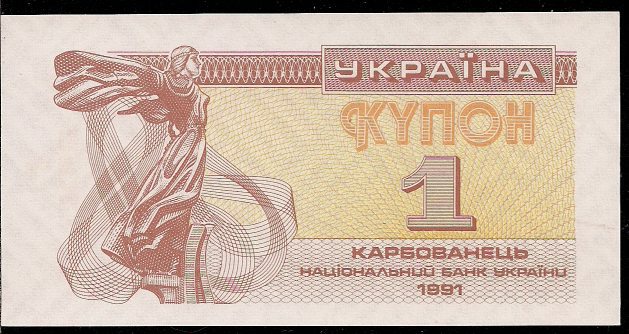
My son recently joined a coin club. At his first meeting, he was given three banknotes from different countries and was given the task, by the next meeting, to learn where they were from and what they were worth. Which is pretty easy when the notes are written in English, and a little more work when they are a different language but the same alphabet. It's an altogether ball of wax when the notes are written with a different alphabet - like this:
What a wonderful ride we had on the internet superhighway! Nicholas suggested we type "Kynoh" into our search engine and from there we learned about the geography and history of eastern Europe, had a brief introduction to macroeconomics, and learned about exchange rates. We eventually learned that this note was from the Ukraine, it was called a karbovanet, and that it was worth less than a cent before the country changed currencies. We spent most of our morning learning about the other two banknotes too, a dollar from Trinidad and Tobago and a guilder from the Netherlands.
As I prepared lunch, I mentioned to him that our morning was one of the reasons I was so excited to homeschool. If I were still working, he likely wouldn't be in the coin club in the first place, let alone have the time to deep dive into the research we did this morning. I am so thankful for this road we are on.
Tuesday, 30 October 2012
It's gargantuan
We carried our solar system theme into today. My goal today was to help the children understand the size of each of the planets relative to one another, and the vast size of the solar system (or rather, just the part that we know of). Fortunately, we had picked up a fabulous book at the library, 13 Planets: The Latest View of the Solar System, to help me out with that. This was the same book I used to introduce the planets.
At the end of the book, the author (David A. Aguilar) provides instructions of using everyday pantry items to recreate a scale model of the solar system. This afternoon, we gathered up these items and headed outside:
~ grapefruit (we used a small melon): Sun
~ salt: 1 grain for each of Mercury and Mars
~ raw sugar: 1 grain for each of Venus and Earth
~ baking soda: 1 speck for each of Ceres, Pluto, Haumea, Makemake, and Eris
~ cherry tomato: Jupiter
~ grape: Saturn
~ frozen peas: 1 pea for each of Uranus and Neptune
~ orange: for the Sun's next nearest star, Proxima Centauri
~ chalk
~ tape measure
We started out on the corner of our block, then used the measurements from the book to measure out where the planets would be. We got as far as Saturn before we ran out of real estate. And that next-nearest star? With the scale we were using, we would need to go to Halifax!
| I'm standing on "Saturn", while the children are standing on "the Sun" at the end of the block! |
Monday, 29 October 2012
I love Mondays
There was a time, not that long ago, when I really didn't want to get out of bed and head off into the "real" world on Mondays. While I loved the idea of spending time with our family on weekends, the reality was that they were fast-paced as we raced to catch up from the week that was. By Sunday evening, we had not caught up, felt further behind, and were drained - not really stuff that would make one bound out of bed on a Monday.
I've noticed that lately, I've really loved our Mondays. While I can't say that we have indeed "caught up" on anything, I've perhaps let go of the illusion. Instead, I know we've taken care of our bodies, minds, and souls when I feel fresh for the week ahead, knowing what awaits us...and accepting of the mess that we will leave behind as we start a new project, or the required logistics as we prepare for a field trip.
Today was a science day. Jaelyn wanted to learn about the solar system, so we did a little reading about the planets in the solar system (there may be 13 now, not the 9 that I remember from my youth - check here for more info about why the number is in flux). Then, we did some art, using pastels and watercolours, to draw and paint our interpretation of the solar system. What I really loved about this was the opportunity to integrate several "subjects" into one lesson - art, reading, writing, math, science - it's all there! I have a few more projects up my sleeve related to the solar system, which I'll share as we complete them.
Later, we worked on building catapults, so that I could prepare for facilitating a group activity at our next homeschool co-op meeting. This included building different designs, building castles, and hurling little felt balls (which we made on the weekend, much to my delight) around our kitchen. We talked about angles, release points, and tension as we fiddled with the designs. We used glue guns and too many elastic bands to count. It was messy, but it was fun. I loved every bit of today!
Sunday, 28 October 2012
First tries.
We've been trying to rely only on our masonry heater and keep our main source off for as long as possible. We've run into a bit of a snag, as our firewood delivery guy hasn't come yet! So, when it was particularly chilly one morning, I decided it would be a baking day. Nicholas grabbed the chocolate chip cookie recipe, Jaelyn and Astrin made some marvelous saskatoon berry muffins, and I decided I would try to make bread, and we'd get in a little science while we did it.
We experimented with yeast. First, we learned about what yeast actually is (a fungus). Then, we prepared three bowls with water of different temperatures - one cold, one warm, and one hot. We watched, smelled, and learned how the temperature of water impacts yeast.
I've tried to make pizza dough from traditional yeast before - more often than not its been a flop - but never bread. In the first few attempts, I didn't know anything about the science of bread or yeast and didn't pay attention to water temperature. The recipes weren't that helpful either, as they mentioned "warm" water, which is open to interpretation (just ask my daughters if they think "warm" is the temperature that I draw their bath at).
Now, armed with a candy thermometer, a book devoted entirely to bread, and newly found resilience, we tried again. And while the bread erred more on the heavy side, it did rise a bit and was satisfying. After it all, the house was warm, it smelled marvelous, and we had home-made bread to fill our bellies.
| The yeast experiment |
| Fresh bread! |
Monday, 22 October 2012
To see what we could see
I am truly feeling as though a weight has been lifted off my shoulders and that I can be fully present in mothering my children. I feel lighter, happier, more resilient. And with the turn of a page and the start of a new week, it seemed fitting to get a little further from home and go on a field trip back out to a nearby nature refuge. We headed out into the world after we read a poem about Autumn from The Waldorf Book of Poetry.
This is the same nature refuge we visited in early September. I wanted us to get out to the nature refuge at least once a month so that we could see how things change as we roll through the seasons. And what was different in October? At first, I wondered. There was the absence of leaves from the trees, but that felt almost too obvious. Slowly, it came. Once we settled our senses and just let ourselves "be" in that little patch of quiet, it started to come, like peeling the layers off an onion. Yes, the leaves were off the trees. But now we could see the nests that were once so nicely camouflaged and hidden from view. We could better see the bark and the subtle differences between the different species. We could hear the crisp leaves under our shoes as we walked and kicked our way through them. We could imagine a road paved of gold instead of simply the grass covered with yellow leaves.
Then we started to hear the songs and calls of the birds. Though the songbirds were few, they were there - hiding in the thick brush or perched in a tree branch overhead. It took quiet on our part to hear them and search them out. Then the quiet would unravel as the sound of geese passing overhead caught our attention! We craned our necks to figure out where they were coming from - were they landing in the lake, or were they higher up and just passing through? What kind of geese were they?
As we sipped on tea and ate a snack of dried apple slices, I felt myself taken back to that magical place that I discovered when we visited Green Gables in Prince Edward Island. I asked the children about what they saw and heard and felt. The answers came in the form of poetry, much to my surprise and excitement!
I truly did love today. I was thrilled that the children didn't complain of being cold, as the wind was quite brisk despite the bright sun. For those of you who would like to venture outside more often with your little ones as the days grow shorter and colder, here are some tips:
~ Dress in layers on both the top and bottom. Think long johns, knee-high cold-weather socks, and outerwear that blocks the wind.
~ Dress for weather cooler than you expect. It's always easier to strip layers off than wish you had more to put on! Remember mitts, hats and scarves!
~ If your trip involves a car ride, either keep the inside temperature as cool as comfortable, or only put on those extra layers right before you get out of the car. If bodies get too warm and sweaty in the car, they will get too cool outside.
~ Excellent footwear is a must. It can keep dew, muck, snow, and slush off toes and helps make the trek through uneven terrain easier. For some locales, footwear that covers the ankle is also beneficial, as grasses, branches, or other plants may rub against the legs and the ankle area may not have enough protection. Snow may seep in and make for very chilly walking.
~ A warm drink, such as tea, hot chocolate or soup, helps warms the hands and soul.
~ Keep moving! A body in motion will keep warmer than one that is still.
Do you have any tips to share?
Enjoy your cool weather exploring!
Labels:
Field trips,
hands,
head,
heart,
language arts,
science
Wednesday, 17 October 2012
A heart-happy day
Today didn't start out as anything special...in fact, I was suspicious that it would turn into a horrendous day, as all of the children were up early this morning! Nevertheless, it shaped up to be a pleasant day...Jaelyn read a new book to me and we cuddled while a read a new book to her. She also finished off a knitting project (but more on that tomorrow). We went to our homeschool co-op and had a delightful time. I gathered with some fine folks this evening to celebrate our achievements on pulling off a community festival this past September.
The special moments of today seemed to focus around Nicholas. How he announced this morning that he would prefer to write poetry - limericks and haiku, mainly - for all his writing work. He finished a poster about owls and endangered species that he has been working on for the last month and a bit. He discovered at our homeschool co-op that he really likes to do high jump (as well as one can when a pole is suspended from two chairs and there really isn't a thick cushy mat to fall into). On our way home he mentioned finding a track team to join.
Here's hoping you had a heart-happy day too!
Tuesday, 9 October 2012
Club Day. The Birds of Prey Version
Despite the chill in the air, it was a good day for a Birds of Prey Club meeting. Everyone was in good spirits and happy to see each other once again.
Our activity for today was to make a Tsimshian Life Crest. The Tsimshian are a tribe that lived in the Pacific Northwest as long as 5,000 years ago. This tribe was organized as a clan society. There are four main clans: Killer Whale, Raven, Wolf and Eagle (hence, the link to our Club). A child is born into its mother's clan and receives that clan's crest for life. Each clan has traits it is strong in, which are represented by the clan's animal. For example, Eagle is known for peace, friendship, honesty and openness. There are also sub-clans within the clans. The inspiration for today's activity came from Traditional Native American Arts & Activities. We also used First Nations Art Projects and Activities again to help with some of the details in the artwork.
I wasn't sure how well I would be able to explain that the traits of the clan were symbolized in the traits of the clan's animal. And I didn't know how well I could explain that each child could simply choose to draw the animal that best represented him or her on the life crest. So, once the children were nearing the end of their snack, I pulled out a book off our bookshelf called I am Raven and started to read. It is a story of a chief who plans to build a new totem pole before he moves on to the world of his ancestors, and he needs to decide which animals will be depicted on the pole. As he travels through his day, various animals approach him with gifts and comment about how they must be his totem, because his strengths so much resemble their own. In the end, he finds his true totem. It also has wonderful illustrations using the same techniques I was hoping the group would try out today. I was amazed how quiet the group became as I read.
Once the book was done, I described the activity - painting a life crest onto a wooden board. There was a wee bit of chaos as the children grabbed books to learn about what different animals represent or symbolize. Once they settled on what they would draw, and whether they would do a dry run on paper or go straight to drawing on the wood, it got quiet again as everyone got to work. I don't think we've had such a quiet meeting!
After all that deliberation, we wound up with one Killer Whale, one Eagle, one Otter, one Hummingbird, and a mix of Owl, Eagle and Canada Goose. Most tried to make the paintings or drawings in the likeness of the artwork they saw in the books, which was so exciting to see!
Subscribe to:
Posts (Atom)