Showing posts with label science. Show all posts

Tuesday, 18 March 2014

Club Day. The Nature Version.

Today's Club meeting could have gone with the tagline, "Just Play With Your Food."  Which is exactly what we did today.  But it was all with a purpose.  You see, we were experimenting with different bird beak designs and discovering that certain beaks are engineered specifically for the preferred food of its owner.

First, let me introduce you to the tools of our discovery snack.  We used toothpicks (for the birds that like to stab at their meal), spoons (for birds like pelicans that scoop up their food), clothespins and tweezers or chopsticks (for those that grab their meals) and straws (for those who suck their meals, like hummingbirds).


Next, let me share the exotic fare we dined on today.  Cheese transformed itself into caterpillars (you could use marshmallows too); raisins became grubs (any dried fruit would do, though); chocolate sprinkles were the most delicious ants I've ever tasted; puffed rice became insects; sunflower and pumpkin seeds were, well, seeds; oranges were for the fruit-lovers; and apple juice was nectar.  Other things to try include cooked macaroni and peanuts with or without the shells, but I opted to avoid those due to allergy concerns.


The table was set with each clubber having their own set of tools laid out on a napkin, a plate and a glass.  The morsels of delectable food were gathered in the middle which I served.  We tried each of the tools for each kind of food to determine which worked best and wrote our answers down on the chalkboard.  The only rule was to have one hand working the tool while the other hand was firmly behind one's back.  And we had a lot of fun as the Clubbers tried to slurp pumpkin seeds through their straws, stabbed their puffed rice with toothpicks, and attempted futilely to pick up chocolate sprinkles with a clothespin.

 
Yes, it was an action-packed, fast-and-furious snack.  And, as a warning to you if you try it at home, it will most likely leave a big mess on and around your table.  But such is the way of scientific experimentation!
 

As the club went about finishing their snack using their tool of choice, I read the book Beaks!  It has beautiful illustrations.  The reader can read the basics of the different types of beaks and their functions or can deep dive to learn about different bird species, what they eat, and how their beak has evolved to make it easier to enjoy their food of choice.

Thursday, 6 March 2014

Playing with wolves

Jaelyn requested a deep dive into the lives of wolves when we returned to our normal rhythm after the winter holidays.  I must confess that I didn't put in a lot of effort into ordering our activities - they just sort of happened as the books we requested from the libraries started trickling in.  Here's a peek into the resources we used and the activities we did.

We started off our unit by reading Julie of the Wolves by Jean Craighead George.  This is the story of a 13-year-old Eskimo girl who was lost on the tundra and resorted to befriending a pack of wolves in hopes they would bring food to share with her until she made her way back to civilization.  We learned a lot about how wolves communicate and the incredible loyalty wolves possess for the members of their pack.  In fact, there was one day that Jaelyn started giving me commands with wolf-talk - she put her hands on her head like ears, pointed them at me, and bared her teeth.  She was telling me to lie on my belly.  We also learned about the social structure of a pack, as well as Inuit and Eskimo traditions.  Later, we also read through the last two books of the trilogy - Julie and Julie's Wolf Pack.

When Julie met the wolves in Julie and the Wolves, there were pups in the pack.  We further explored the first year of a pup's life by reading Look to the North: A Wolf Pup Diary, also by Jean Craighead George.  This story describes the timing of a pup's development stages with changes in nature or important milestone dates children might remember.  It doesn't use specific dates, and we had difficulty relating to some of the milestones (such as when certain flowers or birds appear further south) so I printed out a calendar and we did our best to identify the development stages based on the milestones we did know (such as when the fireworks fly).

We learned about the important role that wolves play in maintaining healthy ecosystems by watching Wolves:  A Legend Returns to Yellowstone.  We supplemented this by reading When the Wolves Returned, which provided even deeper insight.  For example, it mentioned the detrimental effects of rising elk populations on the trees, which impacted the number of bird species and other animals in Yellowstone.  Since the wolf was reintroduced, there is more diversity in the park.  I really appreciated how a complex subject could be written about in simple terms.  The book ended with a simple food chain that showed the trickle-down effect of wolves on both plant and animal species.

Lastly, we watched several other videos:  Living with Wolves and Wolves at our Door.  Both these videos were shot by a husband and wife team (Jim and Jamie Dutcher) living in a yurt in the mountains of Idaho.  Their closest neighbours was a pack of wolves, which they were observing to learn more about their social behaviours.  This duo also put together a book with amazing photography called The Hidden Life of Wolves

For each book or video we watched, I asked Jaelyn to draw a picture from a favorite page or scene.  Later, she would narrate what she had drawn.  Other activities we did during our study of wolves was creating a wolf from modelling wax and building a diorama of a wolf pack's habitat.  And there has also been lots of impromptu play-acting - like the "pups" ganging up on the alpha male and trying to assert themselves as the alpha, or Jaelyn identifying herself as the pack beta and making sure all was well with each pack member.  This play-acting is by far my favorite part of homeschooling.

We finished off our unit on wolves with a trip to the zoo while on vacation.  Our hope was that the wolves would be active and we could try to guess what their behaviours were communicating.  Unfortunately for us, the wolves were communicating that they were sleepy.  I guess that happens in the life of a wolf too - it just doesn't make for good TV or reading.

What projects have your little ones been immersed in?

Tuesday, 4 March 2014

Club Day. The Nature Version.

After an extended hiatus due to family vacations and my own continuing professional development, Nature Club was back in business.  I committed to working through the Feathered Friends materials from the Cornell Lab of Ornithology.  I started the program late, though - it is a program with activities for September to May, but we didn't really get into it until we started up in January.  Aside from the activity about migration, which is listed as an October activity that I will postpone until April, the topics haven't been too dependent on the seasons.

Our focus at this meeting was moving like a bird.  We watched a few select videos of birds that have developed distinct ways of moving (this link has a select video for each bird that highlights its specific adaptations, while this one gives you a whole library to look and listen through).  Each Nature Clubber got to act out one of the birds we watched, and then we talked about how the bird was built for its movement.  For example - the ostrich is built to walk or run because its size prohibits it from flying.  Loons are at home in the water, partly because their feet are built to make them excellent swimmers.

We took our bird movements one step further by heading outside to play "Birdy Says", inspired by Simon Says.  We worked out a few bird movements for other birds - hummingbirds, vultures and penguins, then had fun flitting and jumping and waddling around in the snow. 

Tuesday, 4 February 2014

Club Day. The Nature Version.

What is a habitat?  How does one explain what plants and animals need to seven year-old kids, most of whom have been inside lots owing to our string of cold days?  Reading a story seems to do the trick more often than not.  Or perhaps I'm just lucky that this group of Nature Clubbers seems to have a love for learning, whether it's after the school bell's rung or not.  At any rate, I introduced the concept of habitat by reading the book, On Meadowview Street, by Henry Cole. 

On Meadowview Street is the story about a family who moved to Meadowview Street, but there wasn't a meadow to be found...only well manicured lawns separated by fences.  The heroine in the story, Caroline, finds a flower growing and asks her dad to mow around it.  Soon there are two flowers, then four.  And soon, the dad has decided there isn't much lawn left to mow and sells his lawnmower.  The butterflies and bees who find the yard pleasant appreciate less noise.

The seasons change and summer's hot sun beats down on the rows of houses and Caroline's little meadow.  Caroline observes there are no trees and soon a maple is planted with care, birdhouses are built, and a wren has moved into the neighbourhood.  Then they dig out a spot for a little pond and make sure there are lots of nooks and crannies for creatures to call home.

The neighbours notice Caroline's yard, and appreciate it's beauty.  Soon there are other families making their yards more friendly for the plants and animals who need a place to live.

Using the story, we talked about the plants, insects and animals that we saw in the pictures at the start of the book.  We only saw people.  Then we walked through the changes that Caroline made and what happened as a result.  When the grasses grew long and the flowers bloomed, who moved it?  Why did they move in - what was there for them now that there wasn't before?  Was it food?  Shelter?  Did other creatures move in once the tree was planted?  Why did they move in after the tree - what purpose did it serve?  Why would the creatures need a pond?

From that, we put together the portrait of what makes an ideal habitat - food (flowers for the insects, insects for the birds), cover (shelter, a place to hide), water (to drink or bathe in).  In order to have food, cover and water, there needs to be space - space for the animals to hunt or forage for food, space for the animals to move about, space for them to call home.

Taking all this knowledge, we then drew pictures of a familiar place.  It could have been a schoolyard, a backyard, a park, or an imaginary place.  Then we looked at the spaces the Clubbers created to see if it would make an ideal habitat for birds.  Was there cover?  Was there food?  Was there water?  Was there space?  It didn't matter if they could say "yes" to all these questions - if they said "no", then we talked about what could be added to make it an ideal space for birds.


Finally, we attempted to take a short walk to check out potential habitats in the neighbourhood.  But after being inside so much lately, they just needed space to play outside, with the crisp air freshening their spirits and colouring their cheeks.  What a lovely way to end the meeting!

Tuesday, 21 January 2014

Club Day. The Nature Version.

Welcome back, Nature Club!  It's been awhile since we've seen all of you, and we're happy you could join us today.

I've been planning for our winter Nature Club activities since attending a webinar with the Cornell Lab of Ornithology in the fall.  They were introducing a new resource - Feathered Friends - and as I flipped through the activities I felt they were just right for Nature Club.  Even though the activities are organized by month, the introductory activity, What Makes a Bird a Bird, could work in any month, whether it be September or January.

We read through the book What Makes a Bird a Bird? to get thinking about the characteristics that birds share with other animals (the ability to fly, sing, lay eggs, build nests) and the characteristic that is unique to birds (feathers). 

Then we donned snowshoes and walked to the park, stopping to listen when the songs of the chickadees caught our ears.  It was there we played a game of bird true or false.  We stomped a line to divide the field into two - one side of the field was the "true" side and the other side was the "false" side.  Then the clubbers took their places on the line.  I read out a statement and the clubbers had to decide whether the statement was true or false by running to the appropriate side of the field.  In their snowshoes.  By the end of the game, everyone was thoroughly tired.  But not too tired to hike over to the playground and pretend to be wolves.  Or a girl who lived with wolves.  A low howl from the alpha meant it was time to return to our den.  And while their legs were weary from trudging through the snow, they magically transformed into birds and their wings carried them back to our house just in time for their parents to come get them.   

Thursday, 5 December 2013

From Hectic to Harmonious...Day 3. And Nature Club too.

Today Mama was on a mission.  I'm in a bit of a race against the clock and when the clock strikes zero, gifts for out-of-town relatives need to be in the mail.  Today's project to start and finish was dying play silks.  We worked on yellow ones dyed with turmeric yesterday and they look fabulous - bright and bold.  Today I tried using Kool-Aid mix as the dye and the colours are soft and gentle.  We came home from supper tonight and were greeted by the strange scent of Kool-Aid infused vinegar.  I must admit, I'm feeling a little nauseous.  There are great instructions for dying play silks with Koo-Aid here.

Indeed, the pulse in our household had a "mission" vibe to it.  In a good way.  In a working with purpose kind of way.  There were homemade snacks to make for the birds.  There was an art class to be had at my kitchen table (our instructor today was Jaelyn, who tried out what I imagine wet-on-wet watercolour painting is.  Self-taught, that one).  There were books to be read and letters to write to Santa.  There were freezer-paper stenciled shirts to be painted too.

Somewhat ironically, today's From Hectic to Harmonious challenge was to remove three things from my to-do list.  Note that says remove things, not do them and scratch them off.  It's about prioritizing and letting go of the stuff that doesn't matter.

Today's challenge is tough for me.  I think I've already made great strides to make this year's holiday a little simpler than last year's.   The number of handmades is down, and what I have made was simpler to make in the first place.  There won't be a lot of Christmas baking going on here, and the holiday countdown garland hanging in our living room feels more like a way to be intentional about the activities we want to share with our children and prioritizing time to do them.  So while the garland is new, the activities in it would happen anyway with or without the garland to guide us as to when they happen.

So, after much pondering, scratching my head and furrowing my brow, here is what I've come up with:

  ~ I will turn off Facebook until December 28
  ~ I will keep the computer games turned off too, until December 28
  ~ I will only have one errand morning or afternoon a week.  All of us will need to be super-resourceful if there is some "gotta have" thing.  If something is needed right now, it will need to be found within the four walls of this house.  While I would love for this to apply to everything, I will be practical and reasonable...if we need milk because for some mysterious reason there is none left in the fridge, we'll go get milk.  But I'm not running out at 10:00 pm to get something like, say, glitter.
  ~ I will, without guilt, buy premade stuff if I need to.  The holidays will still be wonderful if we buy premade pie crusts instead of the ones from scratch.  Or if the whole pie is premade. 

And I'm pleased to report I've already had success in purging things from my to-do list.  I was planning to make snow crystals inside today with Nature Club.  This would have required me to pick up dry ice and Styrofoam containers, as well as get the experiment set up and, optimally, test it out.  But with most of our evenings full of other goodness, which I wouldn't trade for a second, I pulled the plug on making snow crystals.  Instead, we read the book, The Story of Snow and made snowflake cutouts from last year's left over printouts.

I knew there would be little nuggets of success scattered throughout this holiday challenge!

Monday, 2 December 2013

Walking with purpose

As I was preparing for the week last night and flipping through the winter curriculum from Lavender's Blue Homeschool, I ran across a page titled Purposeful Work.  In my haste, though, I read it as "purposeful walk".  This phrase, mistaken as it was, stuck with me through today.  As we bundled up to head outside for a bit of (very) fresh air, I wondered how we could get into the headspace to enter the outside world with purpose when our main goal was just to, well, say we went outside.

Funny, though, if we open our eyes to the wonder of nature and Mother Earth, that in itself is purpose.  We hadn't even made it to the corner when our breath was taken away by the haunting beauty of the tree branches covered in prickly-looking, but delicate and intricate frost.  Our ears were treated to the rare sound of a jay's call and we caught a glimpse of the large blue bird as it was making its rounds of the neighbourhood. 


Even though I was surrounded by the rambunctiousness of my seven-year-old and the sorrowfulness of my toddler, I felt of hush of peace come over me.  My son felt it too, I think.  It was like seeing the world for the first time, even though we've traveled the same streets by foot hundreds of times.  There's always something to appreciate, whether it be something novel (like the jay) or something familiar, like the tall spruce trees that sway and creak and moan in the strong winds yet remain firmly rooted in the earth.

And that is why our morning walks and our outside time are so important to our days.  Besides the space to burn off some excess energy, they allow us to soak up all the wonder of nature, if we're open to it.  If we walk out the door with the questions, "What will we see today?  What surprises await us if we only open our senses to them?", we've walked out the door with purpose.  Our walks allow us to deepen our connection to the earth and to the seasons.  They allow us to surrender to the fact that the seasons do indeed change, with each being wildly different and uniquely beautiful and necessary.  They allow us to be reverent to all living things, both growing and dormant.  They allow our hearts to open a bit more when, at times, there is an overwhelming desire to close them tightly and hide away.  They give us the opportunity to learn...understand...appreciate what could never be done justice in a book or a lecture.  They connect us, in an indescribable way, to those who walked the earth before us and those who will inherit it long after we are gone and who have or will experience the same awe and wonder.

I vow not to shudder when donning my winter gear tomorrow.

Friday, 22 November 2013

Club Day. The Nature Version.

In the busyness of our days I find myself writing this post a day late.  Amid making a supper on the fly, preparing for a homeschool co-op class the next day, dreaming up a little bit of science love to carry us into December, and casting on the next project, yesterday was full, full, full.  And that was just after 5:30!

Before all that busyness though, in the afternoon yesterday, we hosted Nature Club.  As I was tidying the kitchen before Nature Club arrived, I pondered that our part of the world looked much different than it did when Nature Club met last.  And that's where I took Nature Club this week - on a sensory scavenger hunt to discover just how much different our world is this week, with its heaps of snow, bitterly cold winds, and shorter days.  Different than the dusting of snowflakes, the mild days and evenings, and the rich smell of rotting leaves of two weeks ago when we made lanterns for Martinmas.

The Clubbers turned into feral wolves as they walked, ran, and crawled to the park.  They howled at passersby, pretended to be playful cubs, and snuck up on unsuspecting prey.  When it looked like they'd worked off all their pent-up energy, we started our scavenger hunt game. 

We started out by sitting in silence for a minute to see if we could hear different sounds than we heard last meeting.  We then walked for a distance in silence to see if we could hear any other different sounds.  And different sounds there were...the breeze, the crunch of snow under our boots as we walked, the sound of ski pants rubbing together, the sound of running noses.

We moved onto bringing our awareness to our sense of touch...whether we could feel anything different.  Most told me about how their toes and fingers felt cold.  We also talked about if we could tell which direction the wind was blowing from, whether we could feel the sun on our faces, or whether our skin felt itchy in our dry winter climate.

At about the half-way point of our walk, we turned our attention to what we could perceive with our noses.  Did the world smell any different?  When first arriving at the park we noticed the aroma of popcorn, which was an oddity.  I was hoping we could catch the smell of wood burning in fireplaces, but I think it may have been a bit early for folks to have lit their evening fires.  Further along, we did notice that the world smelled a bit cleaner...like there was an absence of smell.

Lastly, we used our eyes to look for differences in our natural world from two weeks ago.  As we turned to the west, we noticed a fantastic sunset (and noticed how different it was just five minutes later).  We noticed tracks of animals.  We noticed icicles hanging from the eaves of houses.  And yes, the obvious covering of snow, too.

Monday, 4 November 2013

Surrounded by birds

We're winding down our unit on the human body this week, finishing off with my favorite...the musculo-skeletal systems.  And that means we're that much closer to a field trip to the Science Centre to finish it all off.  And it also means that we'll be moving on to something new.

That something new will be a wee bit of citizen scientist work.  We've joined Project Feeder Watch and will be watching daily to see who happens to show up at our bird feeders this winter.  We're fully stocked on birdseed and kicked off our birdfeeder project by adding a suet feeder as well. 

We were all ready to start observing this morning.  But what did we find?  High winds, blowing snow, icy streets...it's likely the birds were hiding somewhere where they would be well protected and weren't going to come out for a peck or two at the bird feeder (neither was the squirrel that likes to spill the birdseed all over the ground).  Despite the lack of activity, we did put together a hypothesis or two about our observations.  We'll see if our theory that ties the lack of birds at the feeder to the dismal weather will hold true throughout the winter.

We were also treated to a special event tonight.  An expert on the decline of the burrowing owl population in Canada made a stop for a talk in our town tonight.  Nicholas and I went together, with notebooks in hand for taking notes.  We listened intently, jotted little bits and pieces of information down, asked questions, and enjoyed the company of other nature lovers we hadn't met before.  Part of what excited me about homeschooling was the opportunity for my children to dive deep into the topics they love and the chance to learn from and connect with enthusiastic experts that they typically wouldn't have access to in school.  I'm so glad we're getting a taste of that now, and I'm looking forward to more of it in the months ahead!

Thursday, 17 October 2013

The family tree

We've continued to learn about different systems in the human body...I just haven't blogged about it much as of late.  This week, though, we've been working on a special project that we've invited our extended family to help us with.

You see, we're learning about the reproductive system.  And while we've read books like Amazing You!, Changing You!, and Did the Sun Shine Before You Were Born?, added body parts to the alien bodies hanging on our wall, and done some laid-back Q & A, it seemed like a bit of a stretch to find a good, non-invasive hands-on project to reinforce learning. 


So we dove into the world of genetics, dug into our family's history, and started on a quest to discover who we might resemble...where our unique traits came from.  To do this, I selected two traits for us to investigate - eye colour and ear lobes (eye colour because it can be an easier trait to remember and there's less debate about a person's eye colour than hair colour; and ear lobes because they can be easily seen in photographs).  Both these traits also follow a true dominant and recessive pattern, which makes them simpler to work with. 

We created a massive family tree (drawing, painting, colouring and embellishments courtesy of Nicholas).  Jaelyn and I cut out little squares for each person in our family, up to the great-grandparents' generation (lots of measuring going on here, to make sure the squares were the same size).  We asked our parents to do a trade with us...we provide supper and they provide information and photographs to help us uncover the mysteries of who might have influenced our physical characteristics.  We finished half of the family tonight and will finish the rest tomorrow.  After that, our family tree will hang on our wall. 


We were also able to make some predictions.   We expected that a couple who had blue or green eyes would have children with blue or green eyes - there should be no brown-eyed lads or lasses in that match.  As we added information about aunts, uncles, and cousins to our tree, we discovered this hypothesis was true. 

And it was fun to search through photographs - there was a thrill of excitement as we found out something about our relatives and rushed to add it to our tree.  Maybe not as exciting as finding a dinosaur fossil, but still exciting.  And nice to invite our extended family to a place at our homeschool table.

Thursday, 10 October 2013

Club Day. The Nature Version.

There's a lot of inspiration for nature-related projects around this time of year.  I have a bit of a line-up of projects that would all be good for right this very moment, but only so much time before the weather becomes uncooperative.  Given the blustery days we've had and the abundance of leaves that have fluttered to the ground of late, I decided I couldn't wait another two weeks to make leaf tiles, which were a project featured in the 2013 Fall Living Education Journal from Oak Meadow.

There was so much in this project that was fun.  A scavenger hunt for leaves, mushing and manipulating clay, dreaming of what the tiles would look like when they were dry...oh, there was goodness at every turn.

While we didn't need to go far to find just-right leaves - tromping through our front yard was good enough - we still needed to be selective.  We were hunting for leaves that were not too big, yet not too small, combined with enough definition that they would leave a print behind when they dried and peeled out of the clay.  The leaves still needed to be pliable - the leaves that crackled under our feet were best left for raking into piles for jumping in.  Most of the clubbers chose leaves from the raspberry bush, the strawberry patch, the old elms, the baby maples invading my garden boxes, or the high bush cranberry.

Then there was the task of squishing the clay out of its brick shape and into something that could be rolled out with a rolling pin.  We used Sargant air hardening clay, which had a better consistency than other air hardening clays we've used in the past.  It needed just the slightest bit of water to be malleable enough to roll out. 

The project instructions described making a border from wood that was 1/2 inch thick.  I opted not to do this, partly because I didn't have any pieces that were that thickness, and partly because I didn't have enough clay for the Clubbers to make large tiles that were half an inch thick!  We simply cut away the edges with a butter knife and then proceeded with the rest of the instructions.
 
I don't know why I thought this project would leave a simple self-contained mess at best, but that was an error of judgment on my part.  If I were to do it again, I would do it all outside...that way, I could simply hose off any outdoor furniture that got clay or clay-coloured water on it.  And I would have lots of rags handy for spills or clay inadvertently getting here, there, and everywhere.  I would also think a little harder about buying the grey air hardening clay instead of the terra cotta that we used...the red clay really wanted to stain everything, although it is such a gorgeous colour.  Something to think about for next time!


I'm looking forward to seeing what lies beneath!

Wednesday, 2 October 2013

Club Day. The Birds of Prey Version.

Our meeting this week was a little like watching paint dry.  Except we were watching glue dry...really.  We continued on with building our ornithopters (more on that here).  At least along with watching all that glue dry, we have the body built and will be connecting the wings to the body next meeting.

The other wonderful thing that came out of sitting around watching glue dry was the space and time to scheme.  A door to ancient Egypt, with its folklore of Gods and heroes, was opened to one of our Clubbers, and he delightfully shared some of the allure of times long ago with the rest of the Club.  Which led to talk of Greek mythology.  Which then led to a drawing session where they created their own mythological Gods.  Which finally led to role-playing of their mythological world in our backyard.

I love watching how an idea grows organically into something tangible, with each child's own distinct fingerprint left clearly visible for all to see.  How they naturally gravitate to working out the details on paper, so they all can understand what one envisions their characters to embody...its essence and its physical being as well.  How they want to move beyond the two-dimensional form to fully living and breathing their character.  I'm feeling foolish for being in their way for so long.

Don't worry boys, I'll be out of your way soon.

Tuesday, 17 September 2013

Club Day. The Birds of Prey Version.

Ornithopter...I'd never heard of one of these until I started looking for plans for making our own flying machines, beyond the paper airplane variety.  As I searched, I stumbled across ornithopters... flying machines that are powered by rubber bands and designed so that the wings flap to keep them airborne.  I found kits for making them here

We worked together slowly, and got about half-way through their construction in thirty to forty minutes.  Then it was time to open the doors and let them get outside.  The boys' circumstances have changed since the spring...now, none of them attend the same school.  Two are at schools far enough away that they can't just walk over and meet us at the playground or on the way to our house.  They needed to have the space and time to be together and catch up.  This I was able to see with clarity.

So, once we're finished building our ornithopters, they will be on their own.  I won't be preparing any activities for them to do while they are here...they will have the freedom to create their own activities, role plays, skits, and whatever else.  There will be some limits...which materials can be used, the types and sizes of structures they create, as well as limits to ensure everyone's safety.  But for the most part, what they create and how will be theirs to own. 

Today felt like a self-imposed weight was removed.  I am thankful for seeing what was in front of me all along.

Monday, 16 September 2013

I heart my heart

We're taking our exploration of the human body system by system and up next was the circulatory system.  We were fortunate to take our learning outdoors and do a couple really wonderful activities to get the children engaged and interested to learn more.

In researching activities for us to do, I read a comment about science being an incredibly difficult subject for children to learn traditionally because it requires learning both a new vocabulary as well as the actual scientific concepts being introduced.  I even watched a Ted Talk about this very same thing a few months ago.  Sadly, I also witnessed it first-hand when we went through some of the finer details of the digestive system.  I'm finding many library books too detailed for my little ones to discern the main points.  I was thankful to find Hear Your Heart, as it introduces the main points in simple terms and straightforward language.  We kicked off our circulatory system adventure with this book.

We went on to do several experiments and activities, these coming from How the Body Works.  We felt around for our pulses and learned that the feeling is the blood being pushed through our arteries.  We made a stethoscope out of plastic tubing and a funnel so that we could hear our heart sounds.  Then we discovered that our heart beats faster after exercise...and the more intense the exercise, the harder and faster it beats.  We learned this by comparing our resting heart rates to our heart rates after one minute of exercise (jumping jacks) and two minutes of exercise (running around the block).  We also learned a bit about blood, including some of the substances in our blood, how a scab is formed, and foods that can help our blood stay healthy. 


There are several pretty neat concoctions in Hands-on Grossology - one for fake wounds and the other for making fake blood.  I'm reluctant because of the mess they will make, but I know the kids would get a kick out of it and would likely make them again as they continue their battle scenes.  We'll see if my reluctance lifts as the week progresses.

Friday, 13 September 2013

River of Words

A nature hike was a beautiful way to end our week.  Leaving the city before the sun rose too high and the air got too hot, we made our way to a peaceful patch of land.  A place where we could walk amongst the aspens, anticipate what would await beyond the bend in the path, and feel peace enter our bodies with each deep inhale.  A place where we could be playful, romp with friends, and be transfixed by the little creatures we met along the way.


At the mid-way point of our hike we came to an intersection where several paths met.  It beckoned us to dump our packs, sit down in the shade and enjoy a little time in contemplation.  I brought out a book we're reading excerpts from - The Pillow Book by Sei Shonagon - and read a passage to introduce our first opportunity to write out a list poem, as suggested by a writing program I found, River of Words.   

Our family has been reading passages from The Pillow Book all week.  The author, a lady-in-waiting living in Japan about 1000 years ago, writes about nature and the world that surrounds her.  Some of her revelations are surprisingly as relevant now as they were a millennia ago.  In what we've read so far, she manages to observe the simple, finer details that one hurriedly passing by might otherwise miss.

After reading a passage, we would go around the table and add our insights to the topic of her poem.  A wedding gown might be added to the list of Elegant Things; a puppy without an owner might be added to the list of Depressing Things.  It was all very impromptu and off-the-cuff...no transcribing what was said (though there are moments I wish I had), just slipping off into a dream world and sharing the first thing that came to mind.

We did something similar while on our walk in the woods.  I prepared index cards with some of the passage titles from The Pillow Book.  We picked one...Elegant Things...then went around the circle to each person to add their own thoughts.  Each child had an opportunity to share a category or topic that wasn't on the index cards, such as Things that Fall From the Sky, Flowers, Insects.  Lastly, each child was invited to pick a card, including the blank ones not used, to write their own list.  The younger ones had an adult scribe for them while the older children worked on their own. 

Now, I sit in my kitchen with a bulletin board, and the cards we used this morning are affixed to it.  I'm not sure what permanent home this bulletin board will have, but my hope is that it will be referred to often.  New ideas can be jotted down.  Lines in the poems can be rewritten, reordered, or reread.  New poems can be mined from the lists already started.  It gives us a visual cue to think about the world around us, from the most grand and magnificent to the most minute and timid.   

Wednesday, 4 September 2013

Aliens...but not what you think!

We kicked off the formal part of our homeschooling journey last year with a unit study on the solar system.  It seemed to work for us to do a deep dive into a topic, with lots of hands-on activities and links to language arts and math.  I loved reading the poetry we found, the paintings we created, and the Greek and Roman mythology we followed up every planet with.  And the factoids and science behind the planets and the solar system as well, of course.

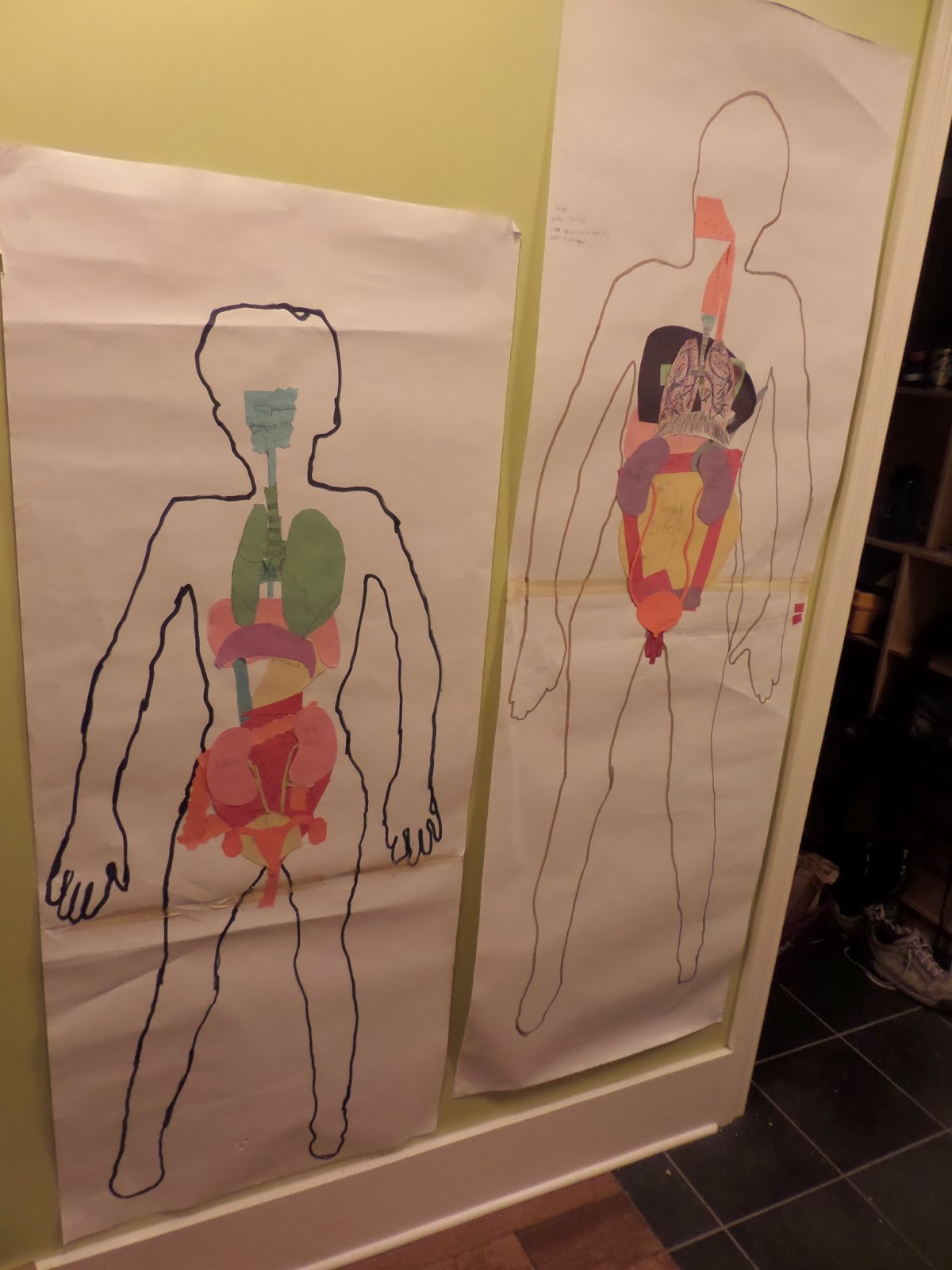
This year we're starting off the year with a deep dive into the human body, with any and all links to others in the animal world happily accepted.  After chatting about all the different body parts - bones, muscles, organs, skin... - we took some time to trace each other.  These life-size representations of the children are now hanging on our walls, and greet any and all visitors who make their way through our front door.  As I was snapping pictures of my new paper greeters, I stood back and realized that they each, in their own unique way, look a bit like aliens.  So alien greeters they are.


In all seriousness though, our intent is to learn about a new body system each week, culminating at the end of the week with drawing, cutting and pasting the system onto the tracings now gracing our walls.  Our first look is into the digestive system.  We've taken a first look at the organs within that system and read a really accessible book - What Happens to a Hamburger? - describing what happens during the digestive process.  We found a length of rope and measured off the length of the digestive system if it was laid out flat on the ground as opposed to twisted and bunched together in the abdominal cavity of a person.  We talked about how long food hangs out in each part of the digestive system.  Fun, quick, hands-on, and great for all ages!  And plenty of factoids too!

Thursday, 11 July 2013

Camping food

There was a time, about a year ago, that I vowed we would eat well on our next family camping trip.  My husband whispered in my ear of all the merits of camping foods from our youth...Kraft Dinner, Pro Stars or Alphabits cereal, and lunch meat.  He talked of how convenient and easy the meals are to make (just add water!), and how it lessens the number of coolers we need to shuffle around and fill with ice every so often.  Oh, and the kids would be happy with a treat for a change.

Despite his best efforts, I just can't bring myself to buying it, let alone making a meal with it.  My rebuttals to he arguments went along the lines of, "Where are the vegetables? Do you know what is actually in that stuff?  Isn't camping a treat in itself?"

But he does have a point.  I would rather play at the beach or sit around the fire than cooking a gourmet meal over a Coleman stove.  I would rather spend less time searching through the several coolers that travel with us trying to find what I'm looking for.  I would rather go on a nature hike than stop at the camp store for more ice.

So out came The Complete Trail Food Cookbook.  Yes, the promise of "just add water" appeals to me.  As I flipped through the pages, it dawned on me that I in fact needed to have dehydrated many of the ingredients before assembling them together.  Which would have made sense to do as we were harvesting last year.  Which I now remember us vowing to do last year.  And I find myself making the same vow now.  No, I will not get tired of putting up food and will do just a wee bit more to have a fully stocked pantry of dehydrated fruits and veggies.  Next year's camping will be awesome.

And as for this year?  I just shrugged my shoulders and found a couple of things that we could make at home instead of buying from the store.  Like syrup for making our own soda. And marshmallows.  (Recipes from Alana Chernila's Homemade Pantry).  Totally not that far off of Kraft Dinner or Prostars or Alphabits or lunch meat in terms of nutritional value.  But I think we score stars for sharing a treat with the kids for a change.

Rhubarb ginger syrup - just add club soda...


The process of turning water, gelatin, and sugar into marshmallows...


Future happy camper!


Tuesday, 25 June 2013

Club Day. The Birds of Prey version.

Today's post could have easily read something like "scavenger hunt gadgetry" or "jackpot denied".  We made the Birds of Prey Club navigation finale all about geocaching.  It seemed like an ideal way to cap off the work we had done on using compasses and understanding latitude and longitude.

Perhaps a definition is in order for those unfamiliar with geocaching.  In my own words, it is like a high-tech, world-wide scavenger hunt.  There are containers, "caches", hidden in various places in neighbourhoods, parks, urban, rural and wilderness locations around the world.  Inside the caches are a logbook and little trinkets - treasure!  Information about the caches, such as coordinates and clues, can be found via a web search.  The coordinates are plugged into a GPS unit, and you use the guidance of the GPS, plus your own smarts, to find the cache.  Once it is found, you sign the logbook and take a trinket, while being sure to leave a trinket for the next person to find the cache.  Oh, and you're supposed to do all this while not arousing the curiosity or suspicions of non-geocachers (known as "muggles" in the geocaching world).

The adventure started this morning, with Nicholas and I navigating our bus system (which currently has numerous detours due to summer construction) to our provincial Parks and Recreation Association to borrow GPS units.  They also provided some easy-to-follow instructions for how to enter coordinates, tips for finding caches, The Complete Idiot's Guide to Geocaching, and a tag we could place inside a cache once we found one.  All for free.  Sweet!

Nicholas and I discovered soon after that this whole geocaching thing sounded easier than it actually was.  In order to be inconspicuous, many caches are quite small and many are camouflaged and well hidden so they do not become accidentally discovered by "muggles".  The GPS is accurate enough to often get the searchers within 10 feet of the cache, but it can still feel like searching for a needle in a haystack, particularly since the GPS can't tell you whether the cache is hidden on the ground, dangling from a tree branch, or shoved into a tiny crevice somewhere in between (though the cache owner can provide hints or clues).  Many caches are also in quite public places (the ones we tried for a test drive were at a gas station and the library), so it felt impossible not to look a little strange while trying to track down these tiny caches.  Unfortunately, we struck out.

The two caches that were in the park by our house were labelled "micro" caches, which means they were similar in size to a roll of film.  Because we hadn't had any luck finding caches in the morning and I feared the same fate this afternoon, I pondered building a cache and hiding it in the park for the Birds of Prey Club to find.  Unfortunately, we ran out of time.  If I had the chance to do a do-over, I would have a contingency cache ready to go so it would be easier to set up a plan B.

At any rate, once the Clubbers were given a brief introduction to the GPS unit, we entered our coordinates and were off.  Of course, everything was easy until that last 10 feet - it appeared that our location was in between 4 trees.  We had a hint that the cache would be hidden about 3 feet high.  So we started our search by looking around each tree.  The Clubbers had interesting approaches to searching...some climbed trees to "get a better view", while others did a quick scan.  I tried to encourage them to think like the person who hid the cache - if it were them, where would they have hidden it?  We also tried to use other clues, such as areas where it looked like there was foot traffic where there shouldn't have been.  In the end, though, we had to wind up our search and we went home empty-handed.

The thrill of the hunt was definitely fun, though.  I think this thing could get addictive very quickly! 

Thursday, 20 June 2013

Club Day. The Nature Version.

Since the spring equinox and the lacklustre attempt I made to celebrate the change of the seasons, I made a commitment to myself to do a better job to welcome summer.  Given that the summer solstice is tomorrow, and with no other ideas really motivating me, I decided to flip through All Year Round for inspiration.  And after a bit of humming and hawing, I chose to lead Nature Club in creating a paper summer solstice spiral.

Before we made our spirals, we talked a bit about the summer solstice.  We talked about the equator and how it separates the northern and southern hemispheres.  We talked about how summer in the north is winter in the south.  We talked about the earth's axis, and how the tilt of the earth leads to the number of daylight hours changing throughout the year.  This led us to a little chat of how ancient cultures created stories to explain the changing seasons and the changing positions of the sun.  We talked about how some cultures believed that fairies would be full of mischief on midsummer's eve.  Then I read a story out of All Year Round called The Rusty Dirk. 

Once we finished the story and tidied up after our snack, we started making our summer solstice spiral.  It was simply two smaller spirals inside one large spiral.  The spirals stay in place by resting on top of wooden beads, which are secured with knots.  The instructions called for gold foil, which I could not find.  I replaced it with a gold translucent vellum paper, which was about normal paper weight.  Next time, I would experiment with a heavier weight paper, even though I think that a heavy card stock would be too heavy.  I found that our six- and seven-year olds were able to do the cutting fairly well, but some needed help with handling the slinky gold thread we used.


Welcome, summer!

Tuesday, 18 June 2013

Tales from the garden

I was so hoping to write a garden post last week.  My husband came home from the community garden one evening and reported that the garden was doing well.  So the next day, with camera in tow, I was excited to capture all the wonderful growth and greenery happening there.

I humbly found I had a different perspective of our garden.  I searched for the corn he said had poked through the earth, only to find three plants.  I squinted to see if there were any carrots growing or if it was just weeds.  The peas and the weeds were so indistinguishable that Nicholas took to hacking at anything and everything green before I could even ask him to slow down, take his time, and be choosy before bringing down the hoe on the green rows.  Then the allure of painting and reading lost its sparkle for Astrin.  And it started to gently and sporadically mist once we had finished our weeding and what we thought was the rest of our planting.  It felt like too depressing a visit to write about.

Time has healed my bruised ego now.  We returned briefly today, so that I could look with objective eyes at the work and replanting that will be done early tomorrow morning, before the kids rise and their father leaves for work.  I can see some of the successes we're having, here at home and at the community garden.  The spindly little tomatoes we started from seed look stronger, greener, and lusher by the day.  The beans Nicholas planted came up beautifully.  The popcorn at home is looking splendid, and I'm happy that I've had a chance to do a little bit of companion planting, using the corn for the pole beans to climb.  The potato leaves have pushed their way through the earth, the pumpkin is hanging on, and the zucchini is well on its way.  And while it's still to early to tell for sure, there may just be a few carrots that appreciated me gently "stirring the earth". 

While I do have a list of "to do's" for next year...get out there earlier, water more often, sow the carrots a bit shallower...I'm once again reminding myself to be patient.  Both with the plants and with me.  The cool, wet spell we've just been through made the growth above ground come to a halt.  But all that moisture will benefit those plants later on.  The sun will be shining this week and the heat will help those plants thrive.  Not all growth goes on where it can be seen...there's equally important stuff going on below the surface.  My vibe can be seen and felt by my children.  They can learn that gardening is frustrating business or they can learn to take the ups and the downs with grace. 


It may be small, but it is a life.  It is growing.  It is beautiful.  I will keep it in that perspective.