I remember lamenting about what to do with that busy toddler of mine who wanted to tear the house apart or run around screeching while I was trying to work with my older children. And while I haven't completely solved that problem (yesterday comes to mind), I have tried to put together a few activities for Astrin that are quiet, stimulating, and hands on. Without further ado, let's go on a tour of what Astrin's mornings look like.
Once everyone is ready to face the day - breakfast eaten, teeth brushed, "outside" clothes on in place of pajamas - the three children go for a walk around the block. This gives me time to clean up the kitchen table and prepare for the lessons ahead. I've found mornings tend to go better with a morning walk - everyone has felt the breeze on their face, breathed in fresh air, and said hello to the sun, birds, and insects that they spot and are ready to embrace the morning's learning.
Astrin and I then do what I'm calling circle time. I have no idea what Waldorf purists would think of our circle time, but it works for us. We sing a greeting song, which I recall my grandmother singing to us as we rose in the morning, followed by a few songs about the body and a couple more about numbers. We cuddle up for a story, then Astrin has time on her own while I move my attention to the older children.
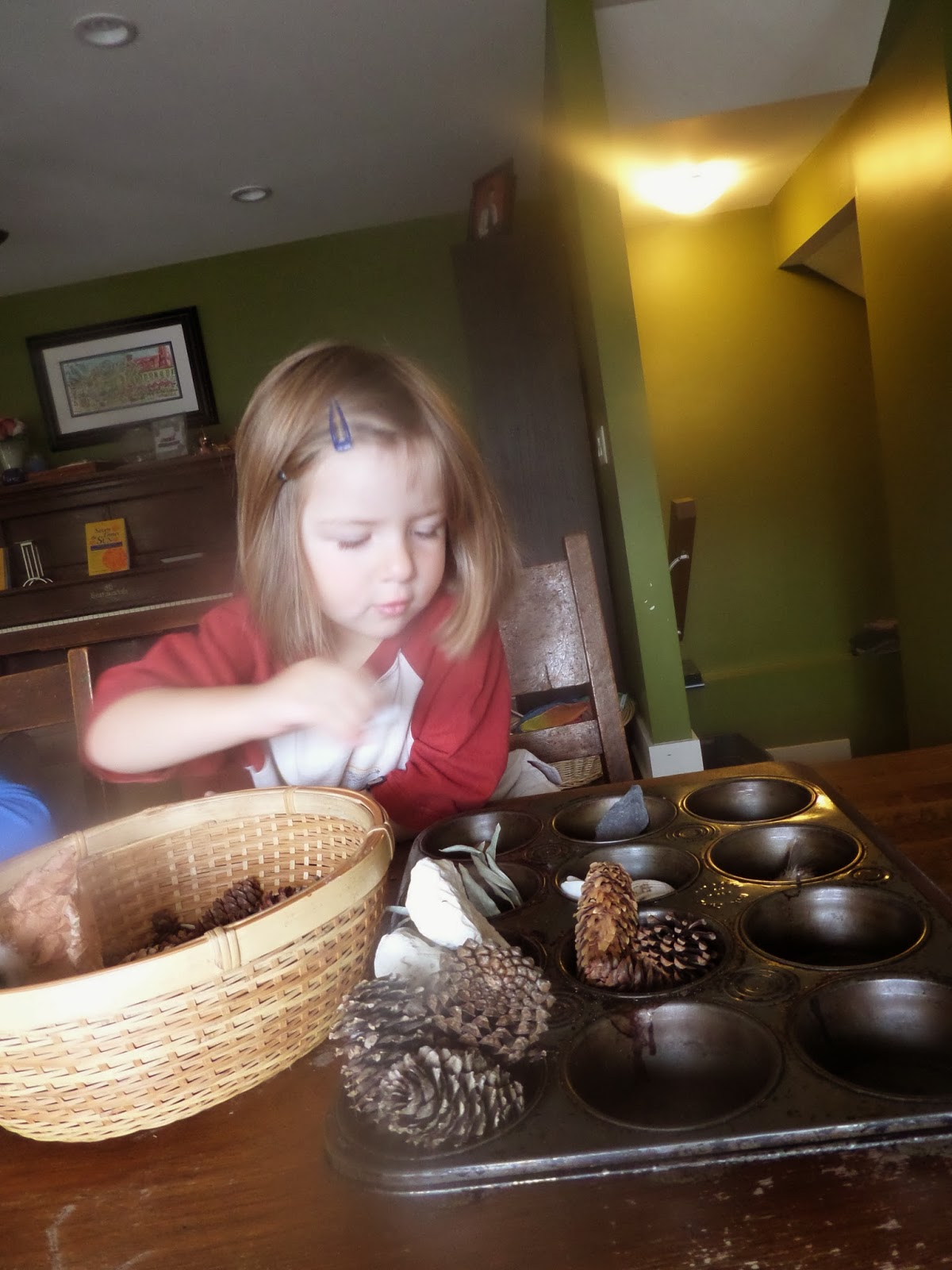
Astrin often chooses what she would like to do during her "free" time. Today she chose to read books. The other day she chose to sit at the table and sort the items in our nature basket. I brought out a cupcake pan and she carefully sorted shells, pinecones, rocks, and other items. She has also used the same cupcake pan to sort beads by colour.
I also created a rice bin for Astrin to play with, upon the advice of another homeschooling mama. It's a pretty simple bin, with cups for pouring, spoons for measuring, and sticks for stirring. When I first brought it out to play with, I told her the rice was to stay in the bin - if rice was thrown then the bin would be put away until another day. Some spills are expected, and in that case, she has her broom and dustpan for sweeping up the mess. While she doesn't sweep up every grain that falls, I'm trying to encourage her to clean up after herself. I must admit this activity has required quite the leap of faith on my part, but we have yet to cut time with the rice bin short!
Quite a few years ago, Nicholas was given a hammer-tic set. It consists of corkboard, a small wooden hammer, various wooden shapes with small holes in them and tacks. The wooden shapes are attached to the corkboard with the tacks and hammer. It turns out that Astrin enjoys this toy! I do need to supervise her, though, because of the small pieces.
Other toys that we have available to Astrin include wooden puzzles, Lego, and dinosaurs. She has paper for colouring, cutting and pasting at her disposal, as well as some nature-themed colouring pages I printed off. And did I mention the books of all shapes, sizes, and topics? She is a bookworm in the purest sense of the word, though she has yet to read a word.
I have plans for making additional activities and materials for her in the winter months. Teaching Montessori in the Home: The Pre-school Years is a great resource for age-appropriate activities for younger children. Stay tuned!
What do you do to keep the harmony with your toddler while working with your older children?
Showing posts with label Montessori. Show all posts
Tuesday, 24 September 2013
Saturday, 1 September 2012
Allowance day
Today is allowance day, and I'm reminded of when my daughter was first learning about money. She was having a difficult time remembering how much different coins were worth, and couldn't remember how many quarters made a dollar. So, we pulled ideas from different teaching methodologies to help her out.
First, I planned an activity based on the Montessori methodology. Jaelyn and I found a quiet corner. I pulled out one of each coin, named it, pointed to the picture on the "tail" of the coin, and the amount. She held each coin and repeated the name an amount. Then, we played a silly little game, where I would ask her to put the coins in different places - say a penny in a shoe, a nickel under a mat, a dime by a door and a quarter on a table. After that, I would ask her to move the coins to different places, in random order. So, she would need to remember the name of the coin and where she put it. Once we had ran out of places to put coins, we huddled together again and I asked her to name each coin for me. This stuck.
To help her learn the number of quarters to make a dollar, I turned to the Waldorf methodology. I thought that if I could make up a story that would be relevant and interesting, it might click for her. I remember laying awake in bed one night coming up with this story. When it was allowance day, I gathered up four quarters and a dollar, as used them as props. To understand the story, it might help to understand what our coins look like. A quarter has a caribou on it, and our dollar is a gold-coloured coin.
Once upon a time, there was a lone caribou herder living far north in the frozen tundra. He had a herd of 25 caribou (point to the caribou and the number 25 on the coin). He would always make sure that his herd had enough to eat, so he was always needing to wander the north looking for more food. Because he was always moving to different places, it was hard to make friends.
But one day, as he was moving his herd, he met another caribou herder! They were both glad to meet someone else! They chatted for awhile and really enjoyed one another's company. The second caribou herder had 25 caribou in his herd too (point to the caribou and the number 25 on the coin). The first caribou herder said, "Would you like to travel with me? I've been so lonely and I really like having someone else to talk to." The second caribou herder agreed, and the first herd of 25 and the second herd of 25 became 50 (bring the two coins together into one hand, representing that they are the same herd).
The two caribou herders and their herd of 50 roamed the tundra, and as they roamed, they talked and shared stories. One day, they met another caribou herder! He had 25 caribou in his herd (point to the caribou and the number 25 on the coin). He was moving his herd to a place that only his family knew about, because there was much for the herd to eat there. He invited the other two caribou herders to join him, for he liked their company. So the 50 caribou joined the 25 caribou and they became a larger herd of 75 (bring the three coins together in one hand).
The 3 caribou herders and their herd of 75 followed inuktuks (rock formations laid by Inuit people) until they came to a valley that had enough food for the herd. They lingered in this spot for many days, and the three caribou herders told stories by the fire and laughed lots. They enjoyed being together. Eventually, the caribou needed to move on to more food, so they packed up camp and set out to find more food. As they came out of the valley, the met a fourth caribou herder, and he too had a herd of 25 (point to the caribou and the number on the coin). When he heard about how the caribou herders helped one another, he asked to join them. And they agreed heartily. The 25 caribou joined the 75 caribou and they became one large herd of 100 caribou.
Eventually, the Queen heard the story of the 4 caribou herders who helped each other out, and their herd of 100 caribou. She asked to meet them. When they met, she gave each of them a gold coin (show the gold coin) to celebrate how they shared and helped one another. She told them, `The gold coin is worth 100 cents - 1 cent for every caribou in your herd. But 100 cents sounds funny, so when you hold this coin, you can also call it 1 dollar.
The end.
I haven`t told that story to Jaelyn for some time. I was reminded of it today, though, so I asked her to retell it, just to see what she remembered. Here`s what she told me:
And the other one said, "Sure". And then they had 50 caribou.
And they were walking along and the caribou were eating and then another caribou herder came along. And so they said, "How about we get together?"
And the other one said, "Sure". So they went together and he also said, `I know where to go to get food for our caribou`. So they went along. There were 75 caribou in their herd.
And so they were eating and walking along and then another caribou herder came along. And so they all three said, `how about you come with us? We know where to go.`
So he said, `Sure I'll come along`. And how many caribou were in the herd? 100.
Then the queen called them over and they came over and she said, "Because you were being so generous by letting people into the herd, and you have lots of caribou and were sharing, you deserve having a gold coin, which is a dollar. Instead of saying 100 cents, you can call it a dollar."
The end.
First, I planned an activity based on the Montessori methodology. Jaelyn and I found a quiet corner. I pulled out one of each coin, named it, pointed to the picture on the "tail" of the coin, and the amount. She held each coin and repeated the name an amount. Then, we played a silly little game, where I would ask her to put the coins in different places - say a penny in a shoe, a nickel under a mat, a dime by a door and a quarter on a table. After that, I would ask her to move the coins to different places, in random order. So, she would need to remember the name of the coin and where she put it. Once we had ran out of places to put coins, we huddled together again and I asked her to name each coin for me. This stuck.
To help her learn the number of quarters to make a dollar, I turned to the Waldorf methodology. I thought that if I could make up a story that would be relevant and interesting, it might click for her. I remember laying awake in bed one night coming up with this story. When it was allowance day, I gathered up four quarters and a dollar, as used them as props. To understand the story, it might help to understand what our coins look like. A quarter has a caribou on it, and our dollar is a gold-coloured coin.
The Four Caribou Herders, original version
Once upon a time, there was a lone caribou herder living far north in the frozen tundra. He had a herd of 25 caribou (point to the caribou and the number 25 on the coin). He would always make sure that his herd had enough to eat, so he was always needing to wander the north looking for more food. Because he was always moving to different places, it was hard to make friends.
But one day, as he was moving his herd, he met another caribou herder! They were both glad to meet someone else! They chatted for awhile and really enjoyed one another's company. The second caribou herder had 25 caribou in his herd too (point to the caribou and the number 25 on the coin). The first caribou herder said, "Would you like to travel with me? I've been so lonely and I really like having someone else to talk to." The second caribou herder agreed, and the first herd of 25 and the second herd of 25 became 50 (bring the two coins together into one hand, representing that they are the same herd).
The two caribou herders and their herd of 50 roamed the tundra, and as they roamed, they talked and shared stories. One day, they met another caribou herder! He had 25 caribou in his herd (point to the caribou and the number 25 on the coin). He was moving his herd to a place that only his family knew about, because there was much for the herd to eat there. He invited the other two caribou herders to join him, for he liked their company. So the 50 caribou joined the 25 caribou and they became a larger herd of 75 (bring the three coins together in one hand).
The 3 caribou herders and their herd of 75 followed inuktuks (rock formations laid by Inuit people) until they came to a valley that had enough food for the herd. They lingered in this spot for many days, and the three caribou herders told stories by the fire and laughed lots. They enjoyed being together. Eventually, the caribou needed to move on to more food, so they packed up camp and set out to find more food. As they came out of the valley, the met a fourth caribou herder, and he too had a herd of 25 (point to the caribou and the number on the coin). When he heard about how the caribou herders helped one another, he asked to join them. And they agreed heartily. The 25 caribou joined the 75 caribou and they became one large herd of 100 caribou.
Eventually, the Queen heard the story of the 4 caribou herders who helped each other out, and their herd of 100 caribou. She asked to meet them. When they met, she gave each of them a gold coin (show the gold coin) to celebrate how they shared and helped one another. She told them, `The gold coin is worth 100 cents - 1 cent for every caribou in your herd. But 100 cents sounds funny, so when you hold this coin, you can also call it 1 dollar.
The end.
I haven`t told that story to Jaelyn for some time. I was reminded of it today, though, so I asked her to retell it, just to see what she remembered. Here`s what she told me:
The Four Caribou Herders, as retold by Jaelyn
Once there was a caribou herder going along. There were 25 caribou in his herd. He was walking along and he found another caribou herder. And then they started talking and one said, "Why don't we go together."And the other one said, "Sure". And then they had 50 caribou.
And they were walking along and the caribou were eating and then another caribou herder came along. And so they said, "How about we get together?"
And the other one said, "Sure". So they went together and he also said, `I know where to go to get food for our caribou`. So they went along. There were 75 caribou in their herd.
And so they were eating and walking along and then another caribou herder came along. And so they all three said, `how about you come with us? We know where to go.`
So he said, `Sure I'll come along`. And how many caribou were in the herd? 100.
Then the queen called them over and they came over and she said, "Because you were being so generous by letting people into the herd, and you have lots of caribou and were sharing, you deserve having a gold coin, which is a dollar. Instead of saying 100 cents, you can call it a dollar."
The end.
Subscribe to:
Posts (Atom)